 Listicle
7 Essential Golf Practice Drills for Home Simulators
Last Updated: November 7, 2026
Quick Summary
The essential golf practice drills for home simulators are the alignment gate drill for setup, accuracy drills that hit a chosen number, the wedge ladder drill for distance control, and TrackMan path and face drills. Build them into a weekly routine with warm-up, block, random, and pressure blocks.
- Set two alignment sticks in a gate around the ball and a third parallel to your target line.
- In the ladder drill, hit your sand wedge to 40, 50, and 60 yards, then work back down.
- Watch only club path and face angle for ten mid-iron shots, changing one variable per rep.
- A weekly routine runs 10 minutes warm-up, 20 block, 15 random, and a 10-shot pressure set.
- Pick just two metrics per session, starting with carry distance and lateral dispersion.
Table of Contents
- 1. The Alignment Gate Drill for Consistent Setup
- 2. Golf Simulator Accuracy Drills: Hitting Your Number
- 3. Golf Simulator Wedge Distance Control: The Ladder Drill
- 4. TrackMan Practice Drills for Swing Path and Clubface
- 5. Building a Golf Simulator Practice Routine That Sticks
- 6. Reading Your Shot Data Without Getting Overloaded
- 7. Booking Your First Structured Simulator Session
- Frequently Asked Questions
1. The Alignment Gate Drill for Consistent Setup
Every good shot starts before the club moves. The alignment gate drill is one of the essential golf practice drills for home simulators because it trains your setup, not just your swing.
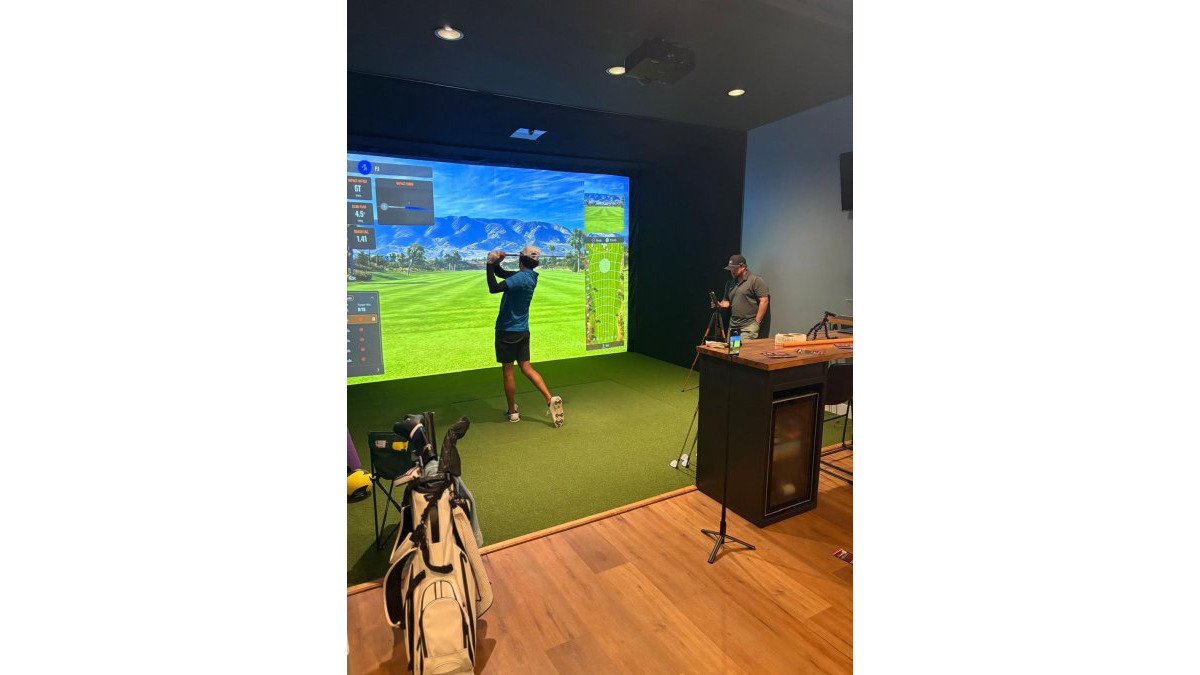
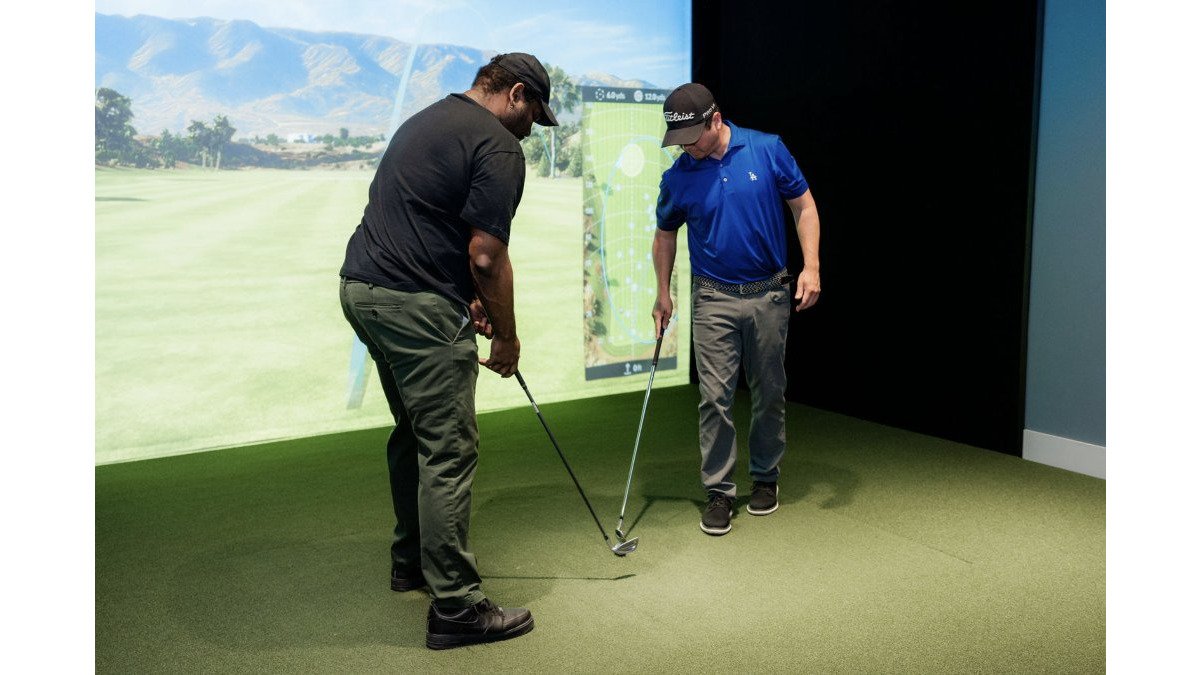
Set two alignment sticks on the mat to form a narrow gate around the ball, then place a third stick parallel to your target line. Step in so your feet, hips, and shoulders square to that line. Hit ten shots at the SVN2 bay, checking your start line on the TrackMan screen after each one.
If the ball starts left of the gate, your shoulders are likely open. If it starts right, they're closed. A common mistake is rushing the setup to get to the swing. Slow down and treat alignment as the first rep of every shot.
2. Golf Simulator Accuracy Drills: Hitting Your Number
Accuracy drills work best when you pick a specific target and commit to it. Choose a flag on the virtual range, note the carry distance, and hit five shots trying to land within a tight dispersion window. TrackMan reports your lateral miss, so you see exactly how far offline each ball finishes.
The goal isn't perfection. It's a repeatable pattern you can trust on the course.
Try this progression:
- Start with a wedge to a mid-range target
- Move to an 8-iron at the same flag
- Finish with driver to a fairway grid
For a deeper look at reading these numbers, our guide on how to read golf simulator data walks through each metric step by step.
3. Golf Simulator Wedge Distance Control: The Ladder Drill
Wedge distance control separates scoring golfers from everyone else. The ladder drill builds feel by asking you to hit the same club to progressively longer or shorter yardages.
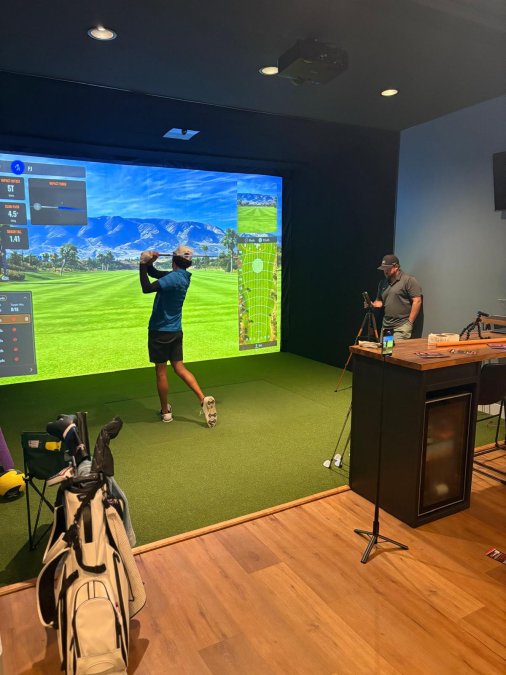
Pick your sand wedge and hit to 40, then 50, then 60 yards, then work back down. Ten balls per rung. Watch your carry distance on screen and adjust your backswing length, not your tempo.
Distance control comes from consistent tempo and controlled length, not force.
4. TrackMan Practice Drills for Swing Path and Clubface
TrackMan practice drills target the two numbers that shape every ball flight: club path and face angle. If your path swings too far left or right, your face angle has to compensate, and consistency suffers.
Set up a mid-iron and hit ten shots watching only path and face. Then try to bring both numbers closer to neutral, one small adjustment at a time. Change one variable per rep. If you adjust grip and path together, you won't know which fix worked.
Want to understand why this data matters? Read our breakdown on why to use TrackMan for golf training.
5. Building a Golf Simulator Practice Routine That Sticks
A structured golf simulator practice routine gives you clear feedback at the SVN2 facility. Structure creates feedback, and feedback creates change. Here's a simple weekly framework:
- Warm-up: 10 minutes of wedges to find tempo
- Block practice: 20 minutes on one skill, like path control
- Random practice: 15 minutes alternating clubs and targets
- Pressure set: 10 shots where each miss costs you a reset
Vary the drills week to week so you don't plateau. Keep a short log of what you worked on and how the numbers moved.
Here is the weekly framework the article lays out for a structured simulator routine.
| Routine block | Time | Focus |
|---|---|---|
| Warm-up | 10 minutes | Wedges to find tempo |
| Block practice | 20 minutes | One skill, like path control |
| Random practice | 15 minutes | Alternating clubs and targets |
| Pressure set | 10 shots | Each miss costs a reset |
Weekly simulator practice routine by block duration
6. Reading Your Shot Data Without Getting Overloaded
More data isn't better data. The fastest way to stall is drowning in numbers after every swing. Pick two metrics per session, study them, and ignore the rest until next time.
For most players, start with:
- Carry distance
- Lateral dispersion
Those two tell you whether you're gaining control. Add path or face angle once the basics feel stable.
7. Booking Your First Structured Simulator Session
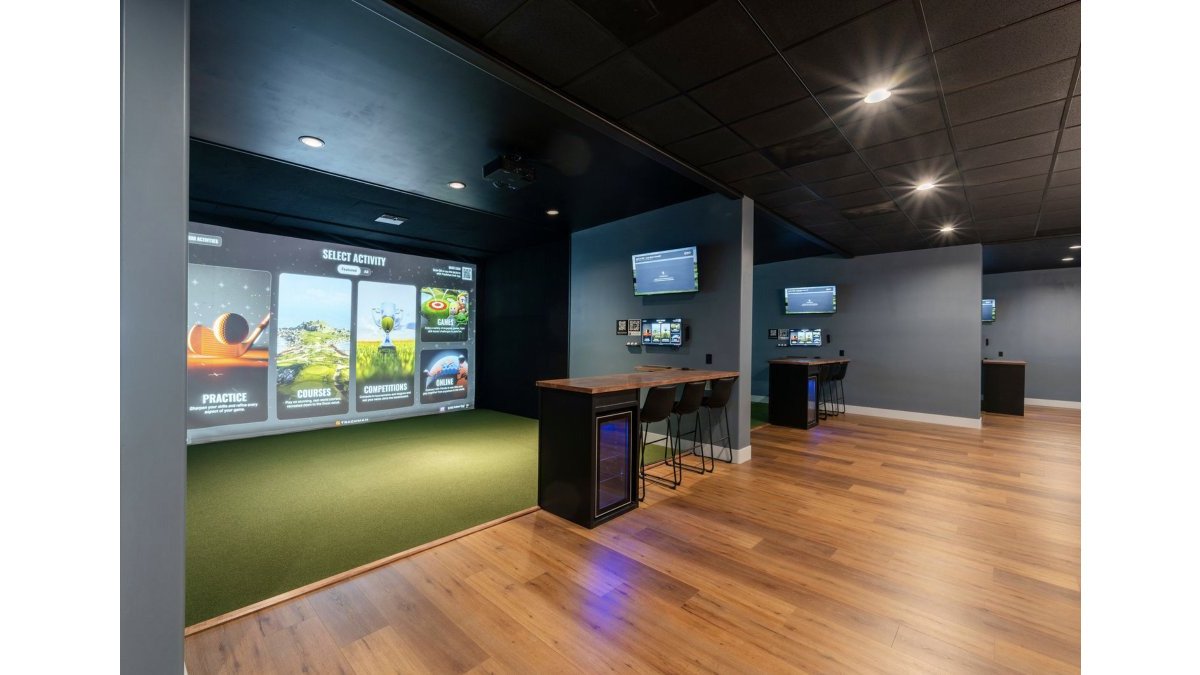
The drills only work if you actually show up and practice with intent. SVN2 Indoor Golf offers fully self-service facilities with TrackMan simulators, so you can drop in and train on your own schedule. Pricing is pay-as-you-go; visit the SVN2 Indoor Golf website for current rates. Community memberships are available for students, faculty, first responders, seniors, and veterans.
Ready to put these drills to work? Our guide on booking an indoor golf simulator session covers everything you need for your first visit. If you want a full session structure, see our seven steps to organize an indoor golf session. And when you're ready to expand your drill library, browse our complete guide to indoor golf practice drills.
Stop guessing at the range and start practicing with data that shows you exactly what to fix. SVN2 Indoor Golf gives you TrackMan simulators, detailed swing breakdowns, and the flexibility to train whenever your schedule allows. Book a session and turn your practice into measurable progress.
Frequently Asked Questions
What is a good practice routine for golf on a simulator?
Start with five minutes of wedges to warm up, then work through one technical drill and one distance-control drill before finishing with a simulated hole or two under pressure. Keep the whole session to about 45 to 60 minutes so focus stays sharp. At SVN2 Indoor Golf, the self-service setup lets you run that structure on your own schedule, and the TrackMan data shows whether each block actually moved your numbers.
How do you practice wedge distance control on a golf simulator?
Hit to a series of targets at set yardages, such as 40, 60, 80, and 100 yards, and record carry distance for each club. Repeat until you can land three balls in a row within a tight window of the target number. The launch monitor feedback tells you whether a miss came from strike, face angle, or speed.
How can you use simulator data to improve your golf swing?
Pick one metric per session, such as club path or face angle, and ignore the rest while you work on it. Hitting ten balls with feedback after each shot builds a clear link between feel and result. Over several sessions, compare your averages rather than single swings. This keeps the data useful instead of overwhelming.
How long should a golf simulator practice session be?
Forty-five to 60 minutes covers a warm-up, two focused drills, and some pressure practice without fatigue setting in. Sessions longer than 90 minutes tend to produce sloppy swings and scattered data. If you only have 30 minutes, skip the warm-up and go straight to one drill plus a short course simulation.
How can you make golf simulator practice more like playing on the course?
Finish every session with a simulated round or a pressure drill where each shot counts. Change clubs and targets on every swing instead of hitting the same club repeatedly, and give yourself consequences for a miss. This random practice mirrors the decisions you face on the course and trains you to commit to a target under mild pressure.