 how-to
7 Steps to Structure an Indoor Golf Session at SVN2
Last Updated: November 4, 2026
Quick Summary
A structured indoor golf session starts with one measurable goal, a fixed session length, and three phases: warm up, focused work, and test. At SVN2, the TrackMan data lets you check each shot against your goal as you go. Keep the work to one skill per session.
- Pick one measurable goal, such as a carry number or a number of good swings, before you arrive.
- Most focused indoor sessions run between 45 and 60 minutes.
- Warm up with short wedges and half swings, then build to full swings with mid-irons.
- Watch two or three TrackMan numbers, mainly carry distance and dispersion.
- Move up a level only after clearing the gate drill twice in a row across two sessions.
Table of Contents
- Set One Measurable Goal Before You Walk In
- Choose a Session Length That Fits Your Schedule
- Build Your Indoor Golf Practice Plan Around Three Phases
- Use TrackMan Data to Judge Every Shot
- Start Beginner Work With Simple Golf Simulator Drills
- Track Progress and Adjust Your Next Session
- Book Your First Structured Session at SVN2
- Frequently Asked Questions
Set One Measurable Goal Before You Walk In
Every good indoor golf session starts before you swing a club. Pick one measurable goal for your indoor golf session, write it down, and keep it visible while you practice at SVN2 Indoor Golf.
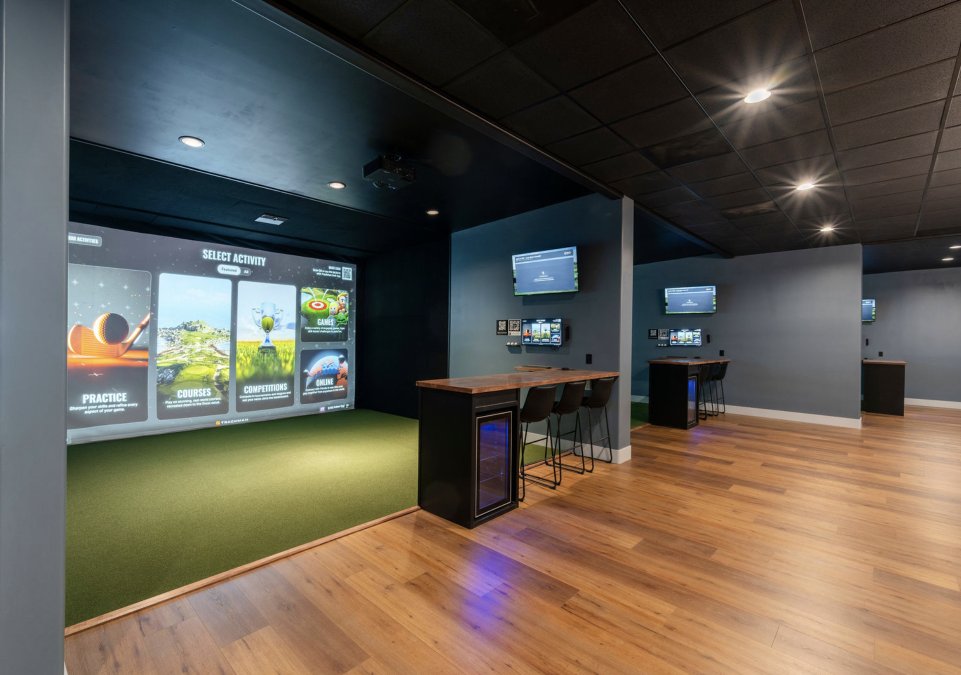
A specific, numeric goal gives your session a clear finish line. A goal like "get better with my irons" does not. You cannot measure it, so you cannot tell whether you hit it.
The TrackMan data at SVN2 can help you check your progress against your goal as you go.
- Choose one club or one shot shape to focus on
- Write down the carry distance or spin number you want
- Decide how many good swings you need before you move on
Choose a Session Length That Fits Your Schedule
Most focused indoor sessions run between 45 and 60 minutes. That is long enough to warm up, work on one skill, and test it under pressure, but short enough to fit around a workday. The mistake most players make is arriving without a time budget, then drifting between drills until the bay timer runs out. Pick your length before you arrive, and commit the minutes to each phase in advance.
Here are three repeatable templates you can run as-is. Each one uses the same three-phase structure, warm up, focused work, test, but scales the time allocation to fit the window you booked.
30-minute template (tight window)
- Warm up: 5 minutes, short wedges and half swings only, building to full swings with a mid-iron
- Focused work: 18 minutes, one drill on one club, roughly 40 to 50 balls, checking data after every 8 to 10 swings
- Test: 5 minutes, 10 target shots to a single fairway or green target on screen
- Review: 2 minutes, note your best and worst dispersion numbers before you leave the bay
60-minute template (standard session)
- Warm up: 10 minutes, wedges to mid-irons, letting the numbers settle before you judge anything
- Focused work: 30 minutes, one skill block with one adjustment at a time, checking TrackMan data after each group
- Test: 15 minutes, a short simulated round of three to four holes, or a pressure set of 10 target shots
- Review: 5 minutes, log your goal result and one adjustment for next time
90-minute template (full session)
- Warm up: 12 minutes, full ladder from wedges through driver, watching ball speed and carry climb
- Focused work: 40 minutes, split into two 20-minute blocks on the same skill, with a two-minute reset between them
- Test: 25 minutes, a six-hole simulated round with a pre-shot routine on every shot
- Review: 8 minutes, compare your baseline numbers to your end-of-session numbers and write the next goal
Watch out: booking a 90-minute bay and running a 30-minute plan leaves you hitting balls with no structure, which is exactly the low-quality repetition these templates are designed to prevent. Match the plan to the booking, not the other way around.
Shorter sessions can work well when you keep your goal narrow. Longer sessions give you room to add a simulated round at the end.
Build Your Indoor Golf Practice Plan Around Three Phases
A solid session has three phases: warm up, work, and test. Keep each phase short and move through them in order.
Phase 1: Warm up (10 minutes). Start with short wedges and half swings, then build to full swings with mid-irons. Watch the numbers settle before you move on.
Phase 2: Focused work (25 to 35 minutes). Spend this block on your one goal. Hit a set of shots, check the data after each group, and make one adjustment at a time.
Phase 3: Test (10 to 15 minutes). Finish with a simulated hole or a set of target shots. This tells you whether the work carried over.
For a first session, keep the focused work to a single skill.
Use TrackMan Data to Judge Every Shot
Judge each shot by the numbers, not by how it felt. The TrackMan simulators at SVN2 provide detailed swing data.
Watch two or three numbers at most. Carry distance and dispersion tell you the most about most shots.
Compare your numbers to your goal, not to the last shot. A single bad swing means little. A pattern across ten swings tells you what to fix.
The numbers below summarise the key points from the TrackMan data guidance above.
| Metric | What it tells you | How to use it |
|---|---|---|
| Carry distance | How far each shot flies | Compare to your goal, not the last shot |
| Dispersion | How consistently shots land | Look for patterns across ten swings |
| Face-to-path | Whether a shot shape is real | Confirm draws and fades against the data |
Start Beginner Work With Simple Golf Simulator Drills
The drills below are organized by skill level so you can pick the plan that matches where your game is, then progress when the numbers show you are ready. Keep club selection simple until the drill is clean.
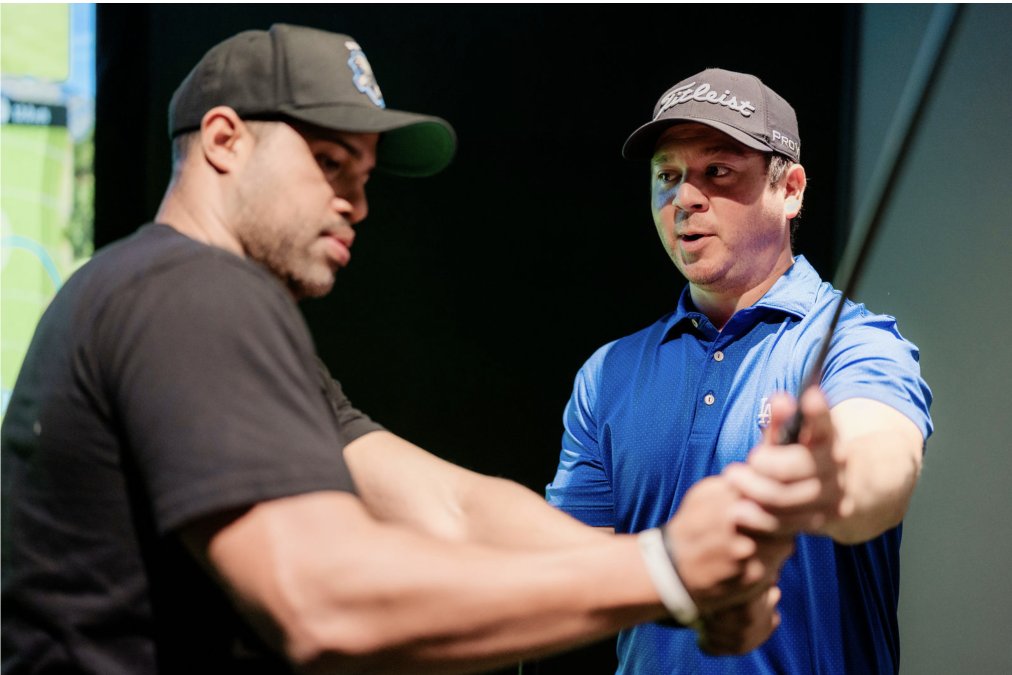
Beginner plan (new to simulators, or working toward a repeatable swing)
- Target practice: pick a fairway target on screen and hit 10 shots to it. Count how many finish inside a 20-yard dispersion window.
- Distance ladder: hit one club 10 times, then move to the next club up the bag. The goal is a consistent carry number, not distance.
- Gate drill: set a narrow dispersion goal and count how many shots land inside it. Start wide and tighten the gate only after you clear it twice in a row.
- Session focus: one drill for the full session. Beginners who try to change too much at once rarely retain any of it. Once a single drill feels repeatable, use the same measured approach to increase your driver distance without changing several parts of your swing at once.
Intermediate plan (can strike the ball consistently, working on control)
- Club ladder through the bag: work from wedge to driver in 10-ball blocks, checking carry and dispersion for each club before moving on.
- Shot-shape block: hit 10 draws and 10 fades to the same target, using the TrackMan face-to-path numbers to confirm the shape is real and not a misread.
- Pressure set: hit 10 target shots and score them, one point for on target, minus one for a miss outside the dispersion window. Track the score across sessions.
- Session focus: one skill block plus one test block. Intermediate players benefit most from testing under a score, not just hitting balls.
Advanced plan (low handicap, working on scoring and transfer)
- Simulated round with a pre-shot routine: play six holes and run the full routine on every shot, including a practice swing and a target commitment. The routine is the drill.
- Dispersion mapping: hit 20 shots with your scoring club and map where they land. Use the pattern to choose targets you can actually hit on course.
- Pressure practice: set a goal that requires a specific number of good shots in a row, and restart the count on any miss. This mimics the consequence of a real round.
- Session focus: split the focused work into two blocks, one mechanical, one scoring, and keep the test phase to a simulated round.
Move up a level only when you clear the previous level's gate drill twice in a row across two separate sessions.
Always complete the warm-up phase before any scored drill, regardless of level.
Beginners often try to change too much at once. Pick one drill, run it for the full session, and save the rest for later. The level you start at matters less than running the same plan long enough to see the numbers move.
Track Progress and Adjust Your Next Session
Close every session with a short review. Save or write down the numbers from your best and worst groups of shots. Note whether you hit your goal.
If you hit it, raise the bar a little for next time. If you missed it, keep the same goal and shorten the drill. Progress at SVN2 comes from small, repeated sessions with clear targets, not from one long grind.
Book Your First Structured Session at SVN2
Ready to try this plan? Book a session at SVN2 Indoor Golf, set one measurable goal, pick your session length, and plan the three phases. Bring your goal written down, and use the Trackman data to check your progress.
Book Now at SVN2 Indoor Golf and build your first structured session around the numbers that matter most to your game.
Frequently Asked Questions
How should I structure an indoor golf practice session?
Start with one measurable goal, such as a target carry distance or a face-angle tolerance. Warm up for 10 to 15 minutes, then move into focused work on that goal using TrackMan range mode. Finish with a short simulated round to test the skill under pressure. Record the key numbers before you leave so the next visit starts from data, not memory.
How long should an indoor golf practice session be?
Many productive indoor sessions run 45 to 60 minutes. That window covers a warm-up, one or two focused blocks, and a brief review of your TrackMan numbers. Longer visits work well when you add a simulated round, but shorter sessions can still produce clear progress if the goal is narrow and the metrics are tracked.
What should I practice first on a golf simulator?
Begin with the club that gives you the most trouble on course, then check its carry distance and dispersion on the simulator. Once you know your baseline, work on the single metric that separates your good shots from your bad ones, such as club path or angle of attack. Save short game and putting for later in the session, when your swing is warm.
How do I use TrackMan data to improve my golf practice?
Pick two or three numbers to watch from your simulator data. Hit a set of shots with the same club, then compare the group averages to your target ranges. Change one variable at a time and re-measure. This keeps the feedback clear and shows exactly which adjustment moved your results.