 How-to
How to Practice Golf with a Busy Schedule
Last Updated: November 10, 2026
Quick Summary
To practice golf with a busy schedule, block two or three fixed 30-45 minute sessions per week and give each slot a single job before you arrive. Roughly 70% of your golf practice time should go to scoring shots: wedges, chipping, pitching, and putting.
- Book two or three fixed practice slots rather than seven flexible ones, since consistency beats volume.
- A 45-minute session is the default recommendation: 15 minutes wedges, 20 minutes putting, 10 minutes full swing.
- Beginners should spend 60% of practice time on setup, grip, posture, and alignment.
- Track two or three numbers every session and review them every two weeks.
- Stacking practice right before or after a round rarely works because it becomes a warm-up.
Table of Contents
- Why Short, Focused Golf Practice Beats Long Range Sessions
- Golf Practice Time Management: Building a Weekly Plan Around Your Calendar
- Efficient Golf Practice Routines for 30, 45, and 60 Minutes
- Trackman Swing Analysis: Making Every Rep Count
- Practice Priorities by Skill Level: Beginners vs. Low Handicaps
- How to Measure Progress and Adjust Your Practice Routine
- Book Your Next Efficient Practice Session at SVN2 Indoor Golf
- Frequently Asked Questions
Why Short, Focused Golf Practice Beats Long Range Sessions
Most golfers believe improvement requires hours at the range. The data says otherwise. According to Edge Golf's practice distribution guidance, roughly 70% of practice time should go to scoring shots: wedges, chipping, pitching, and putting. Long range sessions spent pounding drivers rarely move your handicap.
Short, focused golf practice wins because attention is finite. Athletes can only hold intense focus for so long, which is why Peter Knight Golf's analysis of deliberate practice argues that brief, high-intensity sessions beat long, unfocused ones. A 45-minute session with a clear target does more than two hours of aimless hitting.
Below, we'll show you exactly how to practice golf with a busy schedule, including time budgets, skill-level priorities, and a simple way to track progress.
Golf Practice Time Management: Building a Weekly Plan Around Your Calendar
Golf practice time management starts with one honest question: when can you actually show up? Not when you'd like to. When you can.
The golf community discussions on r/golf point to a practical answer. Many working golfers report that 30-45 minutes during a commute or lunch break is enough for high-quality short-game work. That window is real, and it's repeatable.
Build your week in four steps:
- Block two or three fixed practice slots, not seven flexible ones. Two to three sessions per week is the recommended frequency for steady improvement, according to The Golf Practice's frequency benchmarks. Consistency beats volume every time.
- Put them next to existing commitments, like the drive home from work. A session that requires a separate trip rarely survives a busy week.
- Protect them like meetings. Family commitments come first; practice fits around them.
- Assign each slot a single job before you arrive, wedges, putting, or full swing, so you never spend the first ten minutes deciding what to do.
Here is how a realistic week looks for three common schedules:
| Schedule Type | Available Window | Weekly Plan | What to Skip |
|---|---|---|---|
| Office worker with lunch break | 30 min, 3x per week | Two putting-focused sessions, one wedge session | Full swing until the short game is stable |
| Parent with evening commitments | 45 min, 2x per week | One combined wedge-and-putting session, one full-swing session | Range time on weekends when family time is scarce |
| Traveler or shift worker | 60 min, 1-2x per week | One long session split into three blocks | Extra sessions; protect the one you have |
The trap is planning for the golfer you wish you were. A golfer who books five sessions and attends one is worse off than the golfer who books two and attends both. Start with the minimum that fits your calendar, then add a slot only after four consecutive weeks of attendance.
Watch out: stacking practice immediately before or after a round rarely works. Fatigue and time pressure turn a practice session into a warm-up, and the skills you meant to build get skipped.
For a deeper walkthrough on fitting sessions around a full work week, see how to practice golf after work.
Efficient Golf Practice Routines for 30, 45, and 60 Minutes
Efficient golf practice routines follow a time budget, not a mood. Here is how we'd structure each session length.
| Session Length | Best For | Time Split | Focus |
|---|---|---|---|
| 30 minutes | Lunch break, quick stop | 10 min wedges, 20 min putting | One target, one club |
| 45 minutes | Standard weekday session | 15 min wedges, 20 min putting, 10 min full swing | Two targets, data check |
| 60 minutes | Weekend or lighter day | 20 min wedges, 20 min putting, 20 min full swing | Full bag, progress notes |
The 20-minute putting block is not optional. The Golf Practice's session structure recommends dedicating 20 minutes of a practice session specifically to putting, because it's where strokes disappear fastest.
That 45-minute session is our default recommendation for most busy golfers. It's long enough to work on two skills and short enough to repeat three times a week.
For a full breakdown of how to organize each block, read 7 steps to structure an indoor golf session.
Recommended practice time split for a 45-minute session
Trackman Swing Analysis: Making Every Rep Count
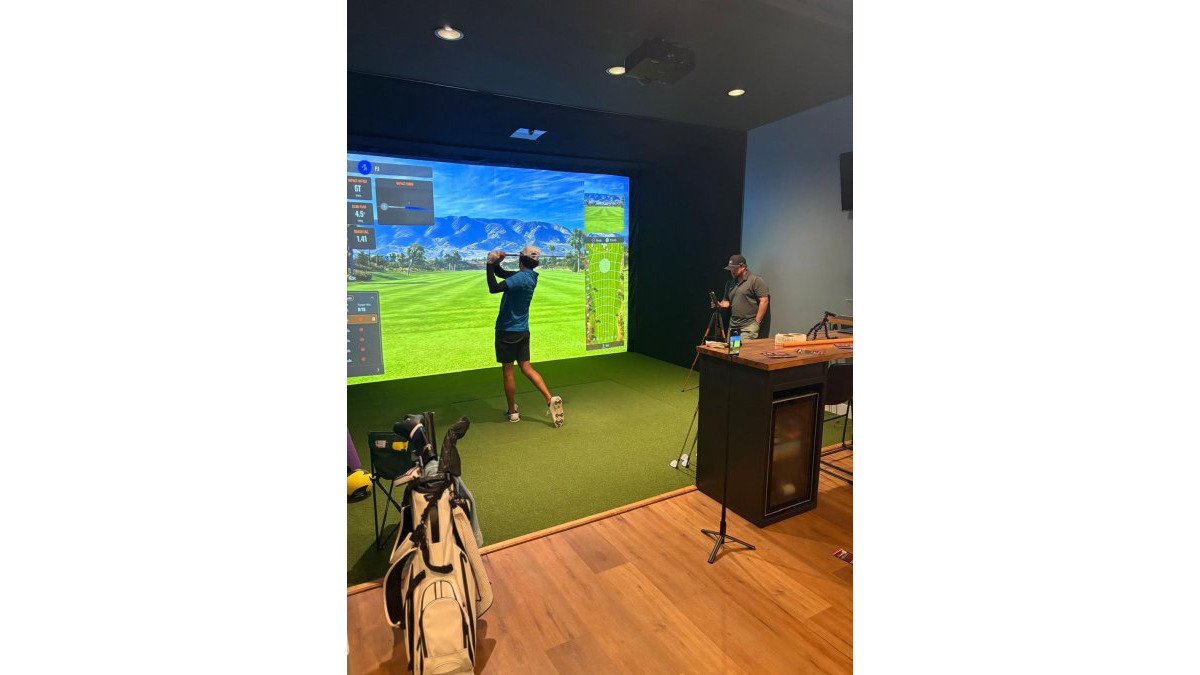
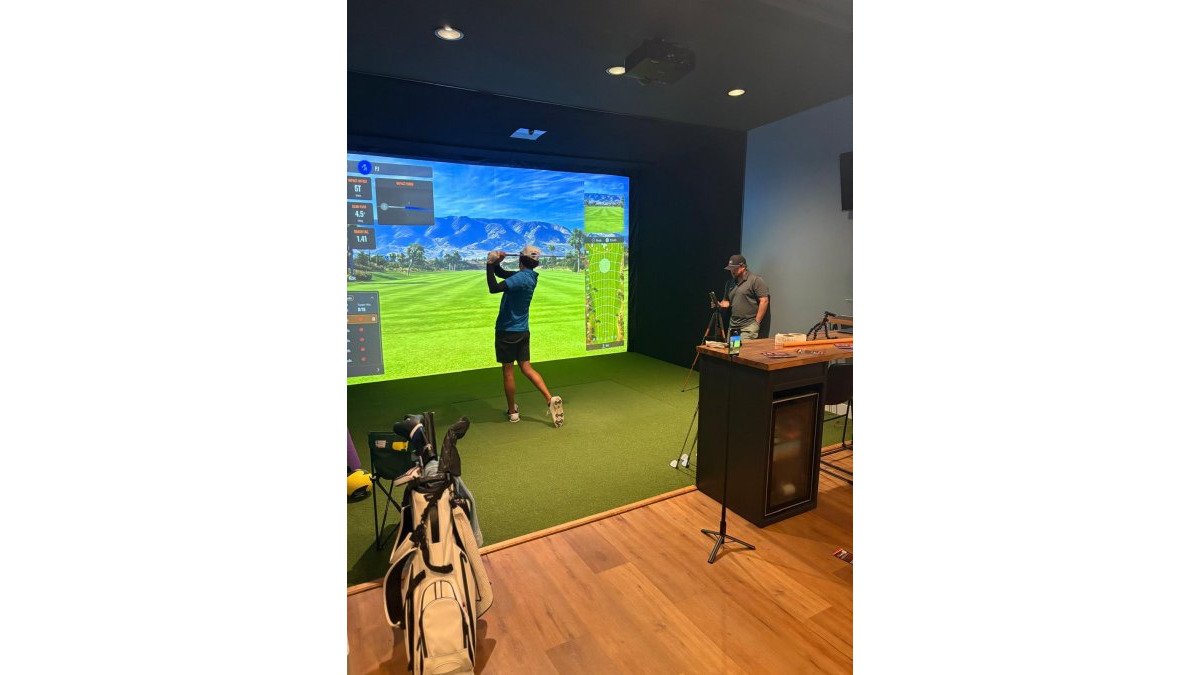
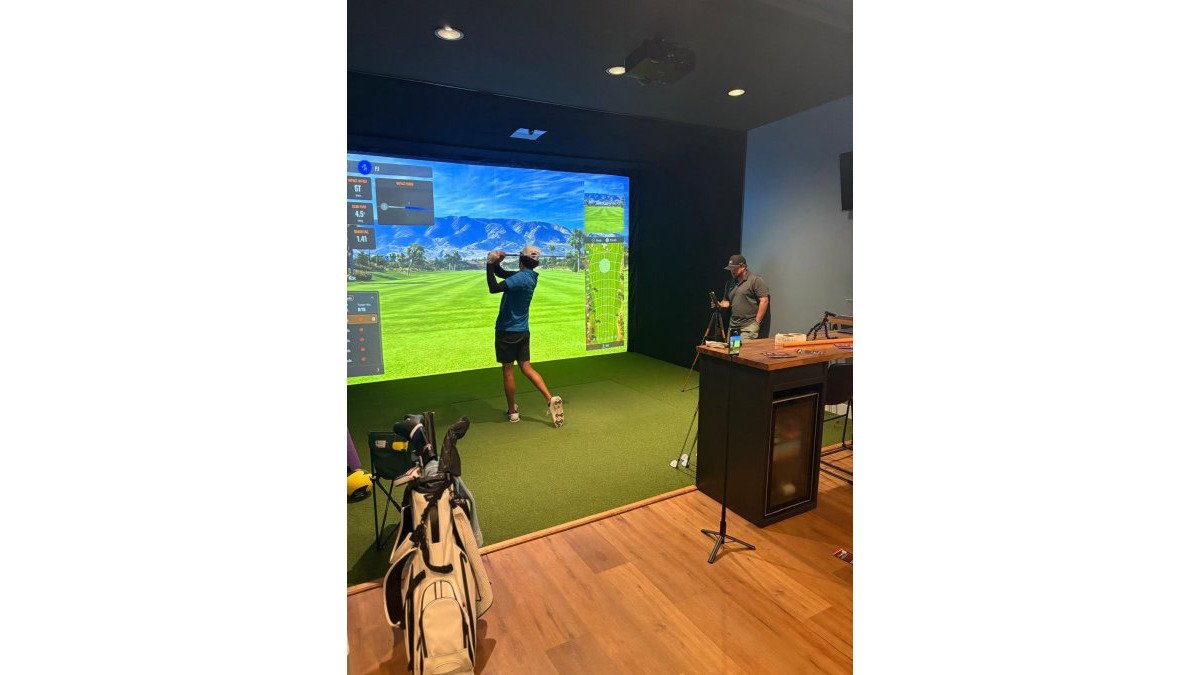
Trackman swing analysis turns practice into feedback. Instead of guessing whether a shot was good, you see the numbers: ball speed, launch angle, spin rate, and carry distance.
A simulator restores that ball-flight feedback.
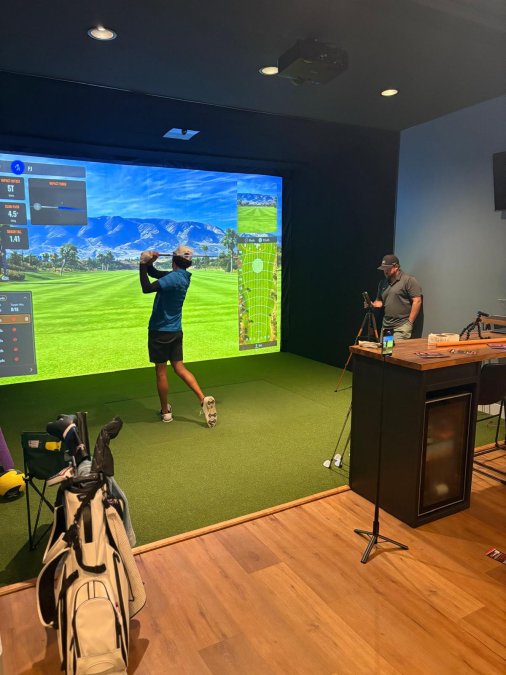
Here's how to use the data without drowning in it:
- Pick one metric per session. Distance control or start line, not both.
- Hit 10 shots, then check the average, not the best one.
- Adjust one variable, then repeat.
To understand why this technology changes practice quality, read why use Trackman for golf training.
Practice Priorities by Skill Level: Beginners vs. Low Handicaps
Your handicap should decide what you practice. Not your favorite club. Here is how we split practice by skill level at SVN2 Indoor Golf.
Beginners (roughly 20+ handicap). Spend 60% of your time on setup, grip, posture, and alignment, 30% on putting inside 10 feet, and 10% on full swing. These foundational skills are cheap to fix and pay off immediately. A square setup with a repeatable grip does more for a new golfer than 100 driver swings. Use the simulator's alignment tools at SVN2 to check your setup before every session, and treat the first five minutes as a setup check, not a warm-up.
Mid handicaps (roughly 10-19). Shift to 40% wedge practice and shot variety, 30% putting, and 30% full swing. Developing a go-to shot and three wedge distances covers most on-course situations. A useful benchmark: can you hit your wedge to three distinct carry numbers within a five-yard window? If not, that is the session's job.
Low handicaps (single digits). Move to 40% putting under pressure, 30% target precision with irons, and 30% driver and tee-shot work. At this level, the gains come from narrowing dispersion, not rebuilding the swing. Set a target circle and track what percentage of shots finish inside it; the number, not the feel, tells you whether the session worked.
A common mistake is copying a low handicap's practice plan. If your ball striking isn't reliable yet, working on trajectory control is wasted repetition. The reverse is also true: a single-digit golfer spending an hour on grip fundamentals is avoiding the putting work that would actually lower scores. Matching practice to your weakest skill makes each session count, and choosing gear that keeps setup simple can protect that same focused time on the course, as Divot King explores.
Watch out: skill level is not the same as ambition. A beginner who wants to break 90 this season should still follow the beginner split for at least eight weeks before adding full-swing volume.
How to Measure Progress and Adjust Your Practice Routine
Progress in golf practice needs a record, not a feeling. Pick two or three numbers and track them every session.
- Average carry distance with your wedge
- Putts made from inside 10 feet, out of 20 attempts
- Shots that finish within your target circle
Review those numbers every two weeks. If a metric hasn't moved, change the drill, not the effort.
Learning to interpret them is the skill. Our guide on how to read golf simulator data walks through each metric step by step.
Watch out: tracking ten metrics at once tells you nothing. Two or three is enough to see a trend.
Book Your Next Efficient Practice Session at SVN2 Indoor Golf
The plan only works if you show up. SVN2 Indoor Golf runs fully self-service facilities with Trackman simulators, so you can drop in when a free 30 minutes appears and get straight to work.
You get detailed swing data on every shot, pay-as-you-go pricing, and flexible training time on your own terms. Community memberships are available for students, faculty, first responders, seniors, and veterans.
As one customer put it: "For any golfer who geeks out on swing data, SVN2 is a must-visit."
Ready to stop guessing? Book an indoor golf simulator session and bring your two targets with you.
Your calendar isn't the obstacle. Practicing without a plan is. SVN2 Indoor Golf gives you Trackman swing data, self-service bays, and pay-as-you-go access that fits a real week. Get started with SVN2 Indoor Golf and turn 45 focused minutes into lower scores.
Frequently Asked Questions
What is the 70% rule in golf practice?
The 70% rule means dedicating about 70% of your practice time to scoring shots: wedges, chipping, pitching, and putting. Only 30% goes to full-swing work with woods and irons.
How do I structure a 45-minute golf practice session?
A focused 45-minute session might look like this: 10 minutes on setup and alignment checks, 20 minutes on putting and short-game shots, and 15 minutes on wedge or full-swing work with a specific target. Use Trackman swing analysis at SVN2 to review your swing data. Keep the plan written down before you arrive so you spend your time hitting shots, not deciding what to do next.
Can Trackman swing analysis help a mid-handicap golfer improve?
Yes. Trackman swing analysis gives you objective data on club path, face angle, launch, and carry distance, which is hard to judge from feel alone. A 15-handicap who has played the same way for years can see exactly where the swing breaks down and track changes over time.
How accurate is Trackman compared to a real course?
Trackman uses radar to measure the actual club and ball flight, so the data reflects what happens at impact. The simulator translates that into a virtual ball flight that closely mirrors outdoor conditions. Practicing with Trackman swing analysis indoors means you can trust the carry distances and shot shapes you see, which helps when you take those numbers to the course.