 blog
How Do You Fix an Over-the-Top Swing?
Last Updated: November 19, 2026
Quick Summary
An over-the-top swing happens when the downswing starts with the upper body and arms, throwing the club outside the target line and causing a slice. Fix it by building a smooth takeaway, shallowing the club from the top with slow driver swings, and using a visual marker to approach the ball from inside.
- Check club path on Trackman; a reading well right of target for a right-hander signals over-the-top.
- Start the downswing with your lower body while your arms follow.
- Set a visual marker just inside the ball on the SVN2 mat to encourage an inside approach.
- Progress from half-speed to full-speed swings only after three consecutive on-path shots.
- Track average club path across ten swings, not your single best shot.
Table of Contents
- What an Over-the-Top Swing Looks Like on Trackman
- The Main Cause of an Over-the-Top Golf Swing
- Fix 1: Establish a Proper Takeaway and Backswing Checkpoint
- Fix 2: Shallow the Club From the Top With Driver Drills
- Fix 3: Use a Visual Cue to Avoid an Outside Path With Irons
- Fix 4: Review Your Swing in Slow Motion to Confirm the Path
- Fix 5: Track Progress With Measurable Checkpoints at SVN2
- Booking Your First Session to Start Correcting Your Swing
- Frequently Asked Questions
What an Over-the-Top Swing Looks Like on Trackman
Coming over the top is one of the most common reasons a golf ball starts right and curves hard to the right, or slices, for a right-handed golfer. At SVN2 Indoor Golf, our Trackman simulators can show this move in the data.

On the screen, an over-the-top swing usually appears as a club path that moves outside the target line through impact. Look for a path reading that is well to the right of the target for a right-hander, paired with an open clubface that produces the slice spin. The numbers make the problem obvious in seconds.
Our simulators give you a detailed breakdown of every swing, so you can compare your path, face angle and ball flight side by side.
The Main Cause of an Over-the-Top Golf Swing
The main cause of an over-the-top golf swing is the downswing starting with the upper body and arms instead of the lower body. The club gets thrown outward from the top of the swing, and the path cuts across the ball instead of approaching it from inside the target line.
A common mistake is trying to fix the slice by aiming left. That hides the symptom but leaves the path problem in place. The fix starts earlier in the swing, at the takeaway and the transition.
Trackman makes this cause easy to confirm. If your club path reads far outside and your attack angle is shallow, you are likely throwing the club from the top rather than swinging down the line.
Fix 1: Establish a Proper Takeaway and Backswing Checkpoint
Start by building a consistent takeaway, because the path you create on the way back shapes the path you make on the way down. Keep the clubhead, hands and arms moving together for the first few feet.
Use the simulator to set a checkpoint. Hit a few shots with a smooth takeaway, then review the club path and face angle on the screen.
- Keep the club on plane during the first hand-high position
- Check that the trail elbow stays in front of your body, not pulled behind
- Confirm your backswing reaches a steady top position on every swing
Fix 2: Shallow the Club From the Top With Driver Drills
Shallowing the club means dropping the handle into a flatter, more inside path at the top of the swing. This is the move that gets the club under the plane and away from the outside path that causes the slice.
Driver work is where most golfers need this change most. At SVN2, use the simulator's driver mode to hit slow, controlled swings focused on starting the downswing with your lower body while your arms follow. Watch the club path number and aim for a path closer to the target line.
Keep the swings smooth rather than hard. Forcing speed usually brings the over-the-top move straight back.
!Golfer at the top of a backswing in an indoor simulator bay with a Trackman screen glowing ahead
Fix 3: Use a Visual Cue to Avoid an Outside Path With Irons
Irons are where the outside path can be felt most clearly, because the steeper attack angle exposes the over-the-top move. A visual cue on the SVN2 mat gives your body something concrete to swing around instead of a vague idea of "swinging from inside."

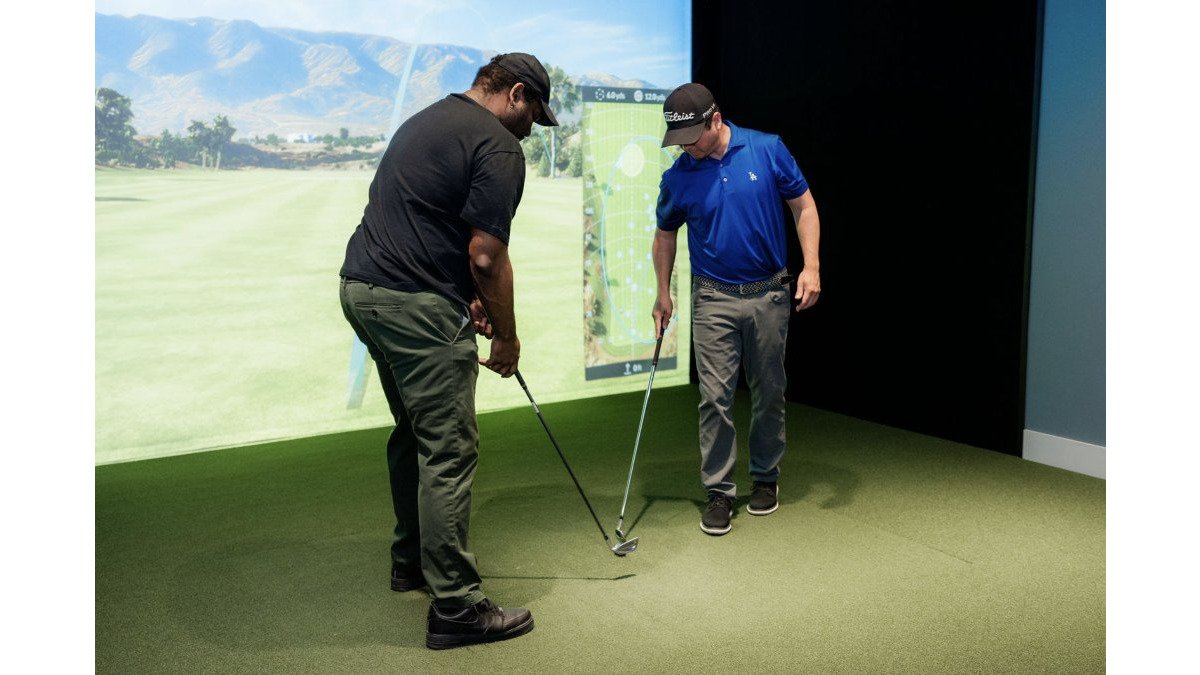
Set up a target line on the simulator's hitting mat and place a visual marker just inside the ball on your intended path. The marker should sit roughly one clubhead width inside the ball and slightly behind it, so the club has to approach from inside to miss it. Swing so the club approaches the marker from inside rather than swinging over it. Check the path reading after each shot to confirm the cue is working. For more on this, read fixing a slice indoors step by step.
Build the drill in three stages so the cue actually changes the path rather than just slowing you down:
- Start with half-speed swings and a mid-iron, watching the club pass the inside marker without touching it.
- Move to full-speed swings only after three consecutive shots show a path closer to the target line on the screen.
- Finish with five shots to a fixed target, checking that ball-start direction and curvature match the new path.
The article's three-stage progression for the iron drill can be summarised as follows.
| Stage | What to do | Move on when |
|---|---|---|
| 1. Half-speed | Mid-iron swings, club passes the inside marker | Club clears the marker without touching it |
| 2. Full speed | Swing at full speed with the same cue | Three consecutive shots show a path closer to the target line |
| 3. Fixed target | Five shots to a fixed target | Ball-start direction and curvature match the new path |
Fix 4: Review Your Swing in Slow Motion to Confirm the Path
Numbers tell you what happened, but slow-motion review shows you how it happened.
Look for the moment the club drops outside the target line. Most golfers see the upper body and arms lead the downswing, with the hands throwing the club away from the body. Once you see it, you can work to start the downswing with the lower body instead.
Compare your slow-motion clips across several swings. The pattern you see is the pattern to change.
Fix 5: Track Progress With Measurable Checkpoints at SVN2
Improvement sticks when you can measure it, and the SVN2 system gives you the numbers to do that on every shot. Set a few simple targets before each session, such as a club path within a set range, a face angle closer to square, or a steadier ball flight.
- Club path: note the average path reading across ten swings, not the single best shot.
- Face angle: track whether the face is returning closer to square at impact.
- Ball-start direction: confirm the ball is starting closer to your intended line rather than being pushed or pulled.
- Contact quality: log strike location and any change in distance or dispersion.
Trackman data can give you those numbers on each shot, so you can see whether your changes are working.
Watch out: do not chase a single number in isolation, because a path that looks better while face angle and contact get worse is not real progress.
Booking Your First Session to Start Correcting Your Swing
Ready to start? Book a session at SVN2 Indoor Golf to work through these five fixes with real Trackman data. Our pay-as-you-go model lets you come in when it suits your schedule, and you get a detailed breakdown of your swing data.
Get started with SVN2 Indoor Golf and see exactly where your path is costing you distance and accuracy.
Frequently Asked Questions
How do I fix an over-the-top swing at SVN2?
Start with a Trackman session to confirm the club path. Then work through the corrections in order: set a takeaway checkpoint, shallow the club with driver drills, use a visual cue for irons, review your swing in slow motion on the bay screen, and track each change against the path numbers.
What is the main cause of an over-the-top golf swing?
The most common cause is the downswing starting with the upper body and arms rather than the lower body rotating toward the target. This throws the club outside the target line and steepens the swing plane. At SVN2, the Trackman club path data makes this visible, so you can see whether the outside-in path is driven by the start of the downswing or by an early release of the arms.
Can Trackman data help identify an over-the-top swing?
Yes. Trackman measures club path, attack angle, and face-to-path, which together show whether the club is moving from outside the target line. A negative club path combined with a steep attack angle is a strong indicator of an over-the-top move. Reviewing these numbers across several swings at the SVN2 bays helps separate a true path problem from a one-off mishit.
How long does it take to correct an over-the-top move?
There is no fixed timeline, because it depends on how long the pattern has been present and how consistently you practice the corrections. Lasting change takes repetition, so schedule regular visits and check your path numbers at the start of each session.