 how-to
How to Fix Golf Slice Indoors: Step-by-Step Guide
Table of Contents
- Understanding Why You're Slicing: Common Swing Faults
- How to Fix Your Golf Slice Indoors: The Grip and Address
- Correcting Your Golf Swing Path Drills for Indoor Practice
- How to Square the Clubface at Impact
- Using Trackman Swing Data Analysis to Track Your Progress
- Indoor Practice Setup: Space Constraints and Equipment Adjustments
- Common Mistakes to Avoid When Fixing Your Slice
- Frequently Asked Questions
Last Updated: September 25, 2026
Understanding Why You're Slicing: Common Swing Faults
A golf slice is one of the most common swing faults among players of all levels. It happens when the clubface is open relative to your swing path at impact, causing the ball to curve dramatically to the right (for right-handed golfers). The slice isn't a random occurrence, it's the result of specific mechanical breakdowns in your swing.
Most slices stem from one of three root causes: an open clubface, an outside-in swing path, or a combination of both. Understanding which fault is driving your slice is the first step toward fixing it. This is where you can fix golf slice indoors with data-driven feedback, making it invaluable.
At SVN2 Indoor Golf, golfers use Trackman simulators to identify exactly which mechanical fault is creating their slice. The simulator breaks down your swing into measurable components: clubface angle, swing path, face-to-path ratio, and ball flight. Without this feedback, you're essentially guessing at what's wrong.
Common swing faults that cause slicing include:
- Open clubface at address, your club is already aimed right of your target
- Weak grip, your hands are turned too far to the left, preventing the club from closing
- Outside-in swing path, you're swinging from outside the target line toward the inside, cutting across the ball
- Poor ball position, the ball is too far forward in your stance, encouraging an open clubface at impact
- Restricted hip rotation, limited rotation forces your arms to take over, creating an outside-in path
Identifying which of these faults applies to your swing requires honest self-assessment or, better yet, swing analysis data.
How to Fix Your Golf Slice Indoors: The Grip and Address
The foundation of any solid swing starts with your grip and address position. These two elements control whether your clubface can close properly through the hitting zone and whether your swing path stays on plane.
Adjusting Your Grip for a Neutral Face
A neutral grip is the starting point for fixing your slice. Your grip determines how easily your clubface can square up at impact. With a weak grip (hands turned too far left), your forearms can't rotate the club closed, leaving the face open.
To establish a neutral grip:
- Place your left hand on the club with the shaft running diagonally across your palm from the base of your pinky to the middle of your index finger
- Rotate your hand slightly clockwise until you can see two knuckles on your left hand when looking down
- Place your right hand below with your palm facing the target, overlapping your left pinky with your right index finger
- Check your right hand, you should see two to three knuckles as well
The key is balance. A neutral grip sits between a weak grip (which leaves the face open) and a strong grip (which can overcorrect and create hooks).
Ball Position at Address
Ball position directly affects your clubface angle and swing path at impact. Too far forward and your club is already open; too far back and you're hitting down excessively.
Correcting Your Golf Swing Path Drills for Indoor Practice
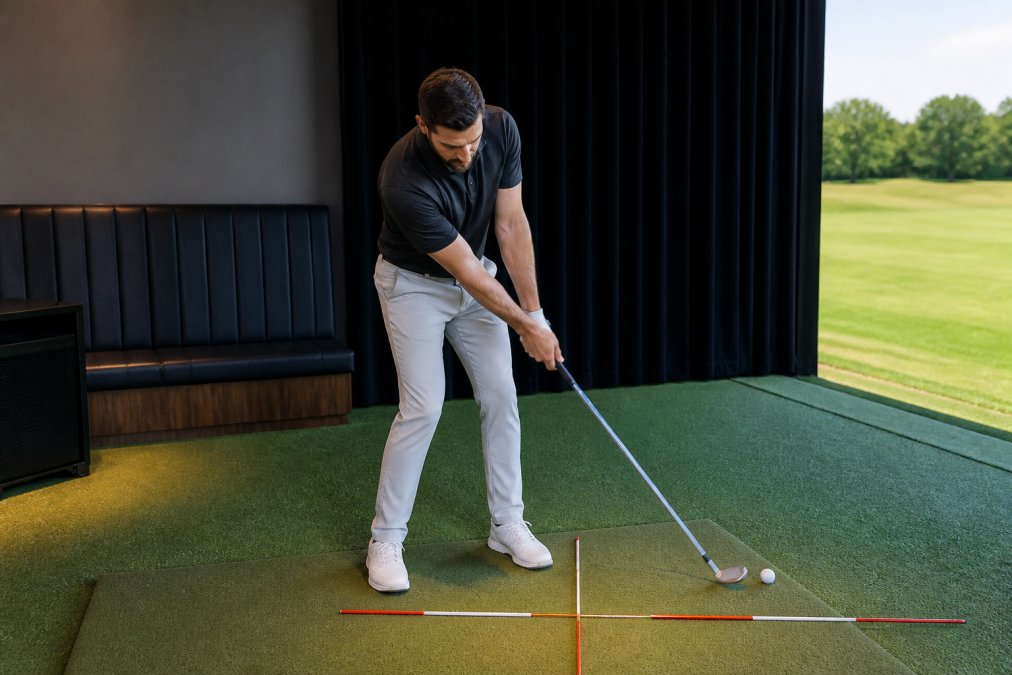
Your swing path is the direction your club travels through the hitting zone. An outside-in path (swinging from outside the target line toward inside) is the primary culprit in most slices. Indoor practice allows you to focus on this specific correction without the variables of wind, course conditions, or distractions.
Inside-Out Swing Path Mechanics
An inside-out swing path means your club approaches the ball from inside the target line and travels toward the target line through impact. This is the opposite of a slice-producing outside-in path.
To develop an inside-out path:
- Start with your feet, hips, and shoulders aligned slightly right of your target (for right-handed golfers)
- On your takeaway, feel the club moving back and slightly inside the target line
- During the downswing, let your lower body lead, your hips rotate first, creating space for your arms to drop into an inside path
- Maintain your spine angle through impact to prevent early extension, which flattens your path
The Takeaway and Downswing Sequence
The takeaway sets the tone for your entire swing. A poor takeaway often leads to an outside-in downswing path because your club gets too far outside early.
During your takeaway:
-
Keep the club low and inside the target line for the first 12 inches
-
Your wrists should hinge naturally, don't force them
-
Your shoulders should rotate, not just your arms moving
-
Initiate the downswing with your lower body (hips and legs)
-
Let your upper body follow, your shoulders rotate after your hips start rotating
-
Keep your arms relaxed and let them drop into position
-
This kinematic sequence naturally creates an inside-out path
How to Square the Clubface at Impact
Squaring the clubface at impact is the single most important factor in eliminating your slice. A square clubface (aligned with your target) combined with an inside-out path produces a draw or straight shot.
Release and Follow-Through Mechanics
Your release is the rotation of your forearms through impact. A proper release closes the clubface and allows your body to rotate fully through the ball.
To develop a proper release:
- Feel your right forearm rotating over your left through impact
- Your wrists should unhinge naturally, don't try to flip or scoop the club
- Your follow-through should be balanced and extended toward your target
- Your belt buckle should face the target at the finish, indicating full rotation
Using Trackman Swing Data Analysis to Track Your Progress
Indoor practice with Trackman data transforms slice correction from guesswork into precision. Trackman measures every aspect of your swing and ball flight, showing you exactly what's happening at impact and how it affects your shot.
Face-to-Path Ratio and Ball Flight Feedback
The face-to-path ratio is the difference between your clubface angle and your swing path at impact. This single metric explains your ball flight better than any other measurement.
- Positive face-to-path ratio (clubface right of path) = slice
- Negative face-to-path ratio (clubface left of path) = hook
- Zero face-to-path ratio (clubface aligned with path) = straight shot
Track these metrics during each session:
- Clubface angle at address
- Swing path angle
- Face-to-path ratio
- Ball flight (direction and curve)
- Spin rate and spin axis
Spin Rate and Shot Shape Correction
Spin rate and spin axis determine your ball's shape and distance. A slice typically has a high spin rate with excessive sidespin, causing the dramatic right curve.
- Your sidespin will decrease
- Your spin axis will move from tilted right to more neutral
- Your ball flight will transition from a slice to a draw or straight shot
Indoor Practice Setup: Space Constraints and Equipment Adjustments
Indoor golf requires different setup considerations than outdoor ranges. Space constraints and simulator technology create unique opportunities and limitations.
Simulator accuracy depends on proper setup:
- Stand at the correct distance from the screen, typically 6-8 feet
- Ensure proper lighting so the camera can track your club and ball
- Use the same ball and club each session for consistency
- Calibrate your swing baseline in the first session so the simulator knows your normal metrics
Common Mistakes to Avoid When Fixing Your Slice
Changing too many things at once. If you adjust your grip, ball position, and swing path simultaneously, you won't know which change actually helped. Fix one thing, practice it for 50-100 swings, then move to the next.
Frequently Asked Questions
What causes a bad slice in golf?
A slice occurs when the clubface is open relative to your swing path at impact. This outside-in swing path combined with a clubface that points right of your target creates the characteristic left-to-right ball flight. The face-to-path ratio is critical: the wider the gap between where your club is moving and where it's pointing, the more severe your slice. Indoor simulators with Trackman technology show you this exact data, revealing whether your slice stems from an open clubface, an outside-in path, or both.
How can indoor simulators help correct a slice?
Indoor simulators provide real-time feedback on every swing's mechanics. Trackman data breaks down your clubface angle, swing path, spin rate, and ball flight instantly. This technology eliminates guesswork: you see exactly what your club is doing at impact, allowing you to make targeted adjustments. You can practice the same shot repeatedly in a controlled environment, monitor improvements in your face-to-path ratio, and build muscle memory without weather delays or range limitations.
What's the easiest way to fix a slice in golf?
Start with your grip. A neutral or slightly strong grip is the foundation for squaring the clubface. Next, focus on your takeaway: moving the club inside the target line during the first foot of the backswing sets up an inside-out swing path. Finally, work on your release through impact to ensure the clubface closes relative to your path. Indoor drills let you isolate each element, practice your grip and takeaway with immediate feedback, and build confidence before applying these changes on the course.
How do I adjust my club path to stop slicing?
An outside-in swing path is a primary slice culprit. To shift to an inside-out path, focus on your hip rotation during the downswing and ensure your club approaches the ball from inside the target line. Indoor swing path drills, such as alignment stick drills and gate drills, help you feel and ingrain the correct path. Trackman data shows your actual swing path angle, letting you see improvements in real time as you practice. Consistent repetition in a controlled indoor environment builds the motor pattern needed to stop slicing.