 comparison
Indoor Golf vs Outdoor Driving Range: Which Fits Your Game
Last Updated: November 1, 2026
Quick Summary
Indoor golf at SVN2 Indoor Golf gives you controlled, data-rich practice on Trackman simulators, while an outdoor driving range gives you real ball flight, wind, and turf. Neither is universally better, so the right choice depends on what you are trying to fix in your game.
- Simulators show why a ball moved, using measured launch angle, spin, and face data.
- Outdoor ranges show what actually happens to the ball in wind and on turf.
- Track two or three numbers per session, such as carry distance and launch angle.
- Look for patterns across 10 to 15 swings before changing your swing based on one shot.
- Use simulator sessions to tune your numbers, then confirm them at the range.
Table of Contents
- How Indoor Golf and the Driving Range Differ
- Trackman Practice: What Swing and Shot Data Show You
- Golf Simulator Accuracy and Its Limits
- Carry Distance in the Simulator Compared to Outdoors
- Driving Range Practice: Real Ball Flight, Wind and Turf
- Which Setting Fits Your Golf Goals
- Booking Your First Session at SVN2 Indoor Golf
- Frequently Asked Questions
How Indoor Golf and the Driving Range Differ
Indoor golf at SVN2 Indoor Golf gives you controlled, data-rich practice on Trackman simulators, while an outdoor driving range gives you real ball flight, wind, and turf. Neither is universally better. The right choice depends on what you are trying to fix in your game.

The golf simulator market reflects this growing interest. Grand View Research estimates the market was valued at $2.1 billion in 2025 and projects it to reach $4.1 billion by 2033, a compound annual growth rate of 8.7% (Grand View Research golf simulator market size and forecast). Indoor facilities are gaining popularity because they are convenient and do not require large outdoor spaces.
The core difference is what you get back after each shot. An outdoor range tells you where the ball landed. A simulator tells you why, using measured launch and spin numbers. Outdoor practice, by contrast, puts wind, lie, and depth perception in front of you, which simulators cannot fully reproduce.
Trackman Practice: What Swing and Shot Data Show You
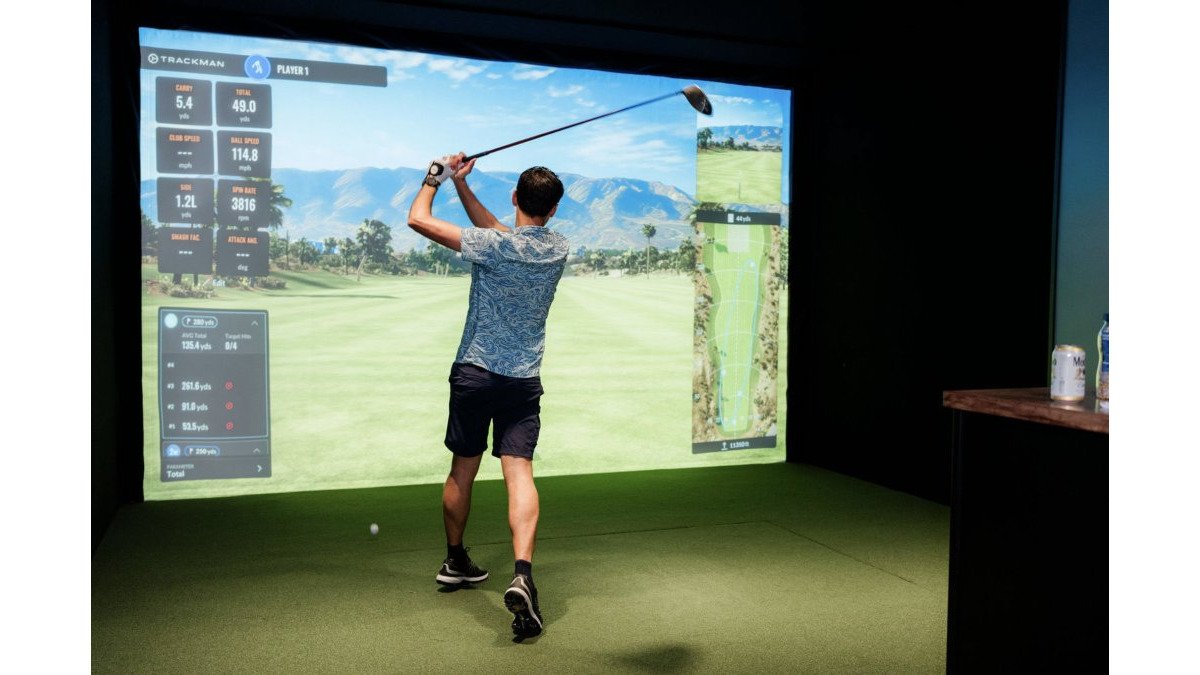
At SVN2 Indoor Golf, every session runs on state-of-the-art Trackman simulators. After each swing, you see a detailed breakdown of the shot. That data helps you zone in on specific yardage and analyze your swing mechanics instead of guessing.
Start by focusing on two or three numbers per session, such as carry distance and launch angle. Trying to track everything at once makes it hard to see what changed. Compare your numbers across sessions to spot consistency problems you would not notice on a range.
Golf Simulator Accuracy and Its Limits
Simulators are precise about what they measure, but they do not replicate every condition of a real course. Understanding how the technology works, and where it stops, is what separates useful practice from misleading numbers.
How Trackman Estimates Ball Flight
Trackman uses a dual-radar system. One radar tracks the clubhead through impact; the other tracks the ball immediately after. From those readings the system measures club speed, ball speed, launch angle, and spin rate, then runs a physics model to project carry distance and full ball flight.
What the Numbers Can and Cannot Tell You
Simulator data is a reliable measure of your swing and clubface at impact. It is not a reliable measure of how a shot will behave on a real course, because wind, lie, turf firmness, and elevation all change the outcome after the ball leaves the face. The National Golf Foundation's research on the golf simulator opportunity covers how facilities use this technology, though the specific accuracy findings are not detailed in the sources available here (National Golf Foundation, The Golf Simulator Opportunity).
A practical rule: trust the simulator for why the ball did what it did, face angle, path, spin loft, and trust the outdoor range for what actually happens to the ball in the air and on the ground.
Carry Distance in the Simulator Compared to Outdoors
Carry distance is one of the most useful numbers a simulator gives you, and it is also one of the easiest to misread. On an outdoor range, wind, temperature, and altitude can change how far a ball travels. Inside, those variables are controlled, so the carry figure reflects your swing more directly.
Use simulator carry numbers to build consistent yardage for each club.
Driving Range Practice: Real Ball Flight, Wind and Turf
A driving range is the right place to test how your swing performs under real conditions. You feel the ball leave the face, see it react to the wind, and hit from grass rather than a mat. Those cues matter for shot shaping and for building the judgment you need on the course.
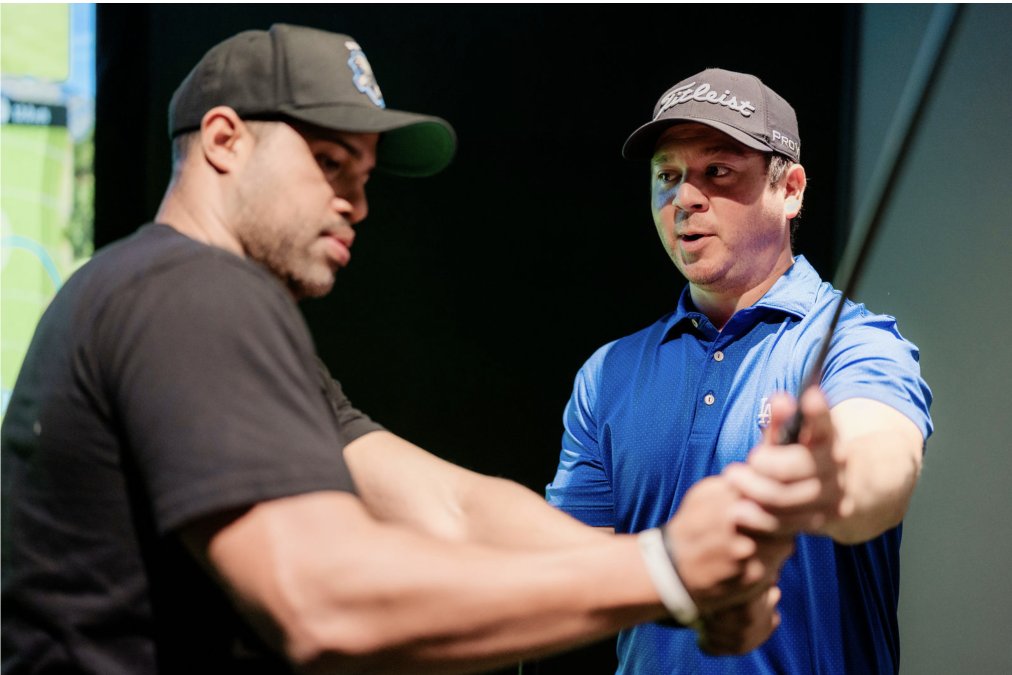
Outdoor practice is weather-dependent, which is its main drawback. Rain, cold, and darkness can cut your sessions short. For many golfers, the best approach is to use the range for feel and the simulator for measurement. Integrating a home golf simulator into your routine provides the consistent data necessary to bridge the gap between casual practice and meaningful improvement.
Which Setting Fits Your Golf Goals
Match the setting to your goal, not to habit. Most comparison articles stop at "indoors for data, outdoors for feel." A more useful framework is to start with what you are trying to improve and let that drive the choice.
A Decision Guide by Golfer Type
| Golfer Type | Primary Goal | Best Setting | Why |
|---|---|---|---|
| Beginner learning the swing | Build a repeatable motion | Indoor simulator at SVN2 | Controlled environment removes wind and turf variables so you can focus on one change at a time |
| Beginner preparing for first rounds | Learn real ball flight | Driving range | Seeing the ball curve in the air builds early shot awareness |
| Experienced player chasing a swing change | Verify a mechanical fix | Indoor simulator at SVN2 | Launch, spin, and face data confirm whether the change actually happened |
| Experienced player preparing for a tournament | Test shot shapes under pressure | Driving range | Wind and turf reveal how the swing holds up outside a bay |
| Lesson-taker working with a coach | Track progress between lessons | Indoor simulator at SVN2 | Session-to-session data gives the coach objective feedback |
| Time-limited golfer | Fit practice into a tight schedule | Indoor simulator at SVN2 | Self-service booking and weather-proof bays remove the two biggest scheduling obstacles |
| Golfer returning after time away | Rebuild feel and confidence | Both | Simulator for rebuilding mechanics, range for real ball flight |
How to Choose in Three Questions
For most golfers, combining both works best. Use simulator sessions at SVN2 Indoor Golf to tune your numbers, then take those distances to the range to confirm them under real conditions.
Booking Your First Session at SVN2 Indoor Golf
SVN2 Indoor Golf is fully self-service, with pay-as-you-go pricing, so you can book time on your own schedule. Pricing depends on session length and availability, so check the SVN2 Indoor Golf website for current rates and booking options. Visit book your indoor golf simulator session to reserve a Trackman bay and start your first session with the swing data you need.
Frequently Asked Questions
What is the difference between indoor golf and an outdoor driving range?
An indoor golf simulator uses a launch monitor, such as Trackman, to measure ball speed, launch angle, spin and carry distance, then displays the result on a screen. An outdoor driving range gives you real ball flight, real wind and real turf, but no automatic measurements unless you bring your own tracking tools. Indoor practice is controlled and data-rich. Outdoor practice is more realistic and more affected by conditions. Which one serves you better depends on whether you need precise feedback on your swing or a closer match to how the ball behaves on a course.
Is a golf simulator as accurate as an outdoor driving range?
Accuracy depends on what you measure. Trackman-style launch monitors are designed to track ball and club data closely, so the numbers they report are useful for spotting trends in your swing. The screen does not replicate wind, lie, or the feel of real turf, so shot outcomes can differ from outdoor results. Use the simulator to understand your ball-striking patterns and the range to confirm how those patterns hold up in open air.
Can a golf simulator help you improve your swing mechanics?
Yes, when you use the detailed swing data to focus on specific measurements, such as club path, face angle and launch conditions, and track how they change session to session. At SVN2 Indoor Golf, the Trackman simulators break down every swing so you can adjust one variable at a time and confirm the change in the data. Pair that feedback with your own observation of ball flight, and you have a practical loop for refining mechanics.