 how-to
How to Lower Golf Handicap Fast: Data-Driven Steps
Table of Contents
- Understand Your Handicap Index and Score Differential
- Track Golf Statistics to Improve Your Game
- Build a Golf Handicap Improvement Plan with Trackman Data
- Master Short Game Practice to Lower Handicap
- Execute Golf Practice Drills to Lower Handicap at SVN2
- Improve Distance Control and Club Selection
- Lower Your Golf Handicap Fast: Your Action Plan
- Frequently Asked Questions
Last Updated: October 16, 2026
Understand Your Handicap Index and Score Differential
Your handicap index represents your golf ability based on your scores and the difficulty of courses you've played, calculated from your best 8 of your last 20 rounds.
The score differential feeds your handicap calculation, measuring how well you played relative to the course's difficulty that day. At SVN2 Indoor Golf, you can analyze every swing and see exactly which shots cost you strokes.
Here's what matters most:
- Your handicap index updates after each round you submit to the USGA
- Only your best scores count, your worst rounds don't hurt you
- Course rating and slope affect how your score translates to a score differential
Most golfers chase lower scores without understanding handicap mechanics. The real path is knowing which shots drag your handicap down, then targeting those weaknesses with precision practice at SVN2.
Track Golf Statistics to Improve Your Game
You can't improve what you don't measure. Tracking golf statistics reveals the exact areas holding your game back, but tracking without a framework is just data collection. The goal is turning numbers into a practice plan.
The most important statistics to monitor are:
- Greens in regulation (GIR): How often you reach the green in the correct number of strokes
- Putting average: Your total putts per round
- Three-putts: How many times you three-putted (a major handicap killer)
When you know your putting average is 35 putts per round, you've identified a clear problem. SVN2 Indoor Golf's Trackman simulators give you detailed swing data for every shot, club head speed, launch angle, spin rate, and ball flight, so you can spot patterns instead of guessing.
A Simple Diagnostic Framework
Use this four-metric scorecard during every simulated round at SVN2 Indoor Golf. Record the numbers after each round and compare them to these benchmarks:
| Metric | Target for Mid-Handicapper | What It Tells You |
|---|---|---|
| Penalty strokes | 0-1 per round | Course management and shot selection |
| Three-putts | 0-1 per round | Putting speed control and green reading |
| Greens in regulation | 6-9 per round | Approach shot distance control and club selection |
| Up-and-down percentage | 40-50% | Short game chipping and pitching |
After each round, circle the metric furthest from target, that's your practice priority for the next week. Four penalty strokes means your next SVN2 session focuses on the shots that caused them, not your putting. Four three-putts means starting on the simulator's putting green.
How to Record Stats Inside the Simulator
SVN2 Indoor Golf's Trackman system captures most of these metrics automatically. After each simulated round, review:
- Putts per round, Compare your total to the target range above.
- GIR, Note the clubs you used on the holes you missed.
- Penalty strokes, Review the shot and decision that caused each one.
For approach shot accuracy, use the Trackman dispersion chart. It shows every shot's landing spot relative to the target. If your misses cluster short and right, that's a pattern you can fix with club selection and swing adjustments in your next session.
Turn Data into Practice Priorities
The golfers who lower their handicap fast track their game obsessively and practice with purpose. Here's the decision tree:
- If penalties are high: Play a simulated round choosing the safe target on every hole and track whether penalties drop.
- If three-putts are high: Use the simulator's putting analysis to check start line and speed, then practice 3-, 6-, and 10-foot putts until you make 10 in a row at each.
- If GIR is low: Hit 20 shots from 150 yards, track how many land within 30 feet, and adjust club selection using the dispersion chart.
- If up-and-down percentage is low: Pitch 20 shots from 50 yards and chip 20 from the fringe, tracking how many finish within 6 feet.
Most golfers practice randomly, hit balls without tracking anything, and wonder why they're not improving. The difference isn't talent, it's whether the data drives the next decision.
Build a Golf Handicap Improvement Plan with Trackman Data
A structured plan beats random practice every time, and it should be built on actual data about your game. Start by analyzing your Trackman data at SVN2 Indoor Golf. Look for inconsistent club distances, where your misses happen (left, right, short, long), club head speed across clubs, and how ball flight compares to target. Once you've identified your top three weaknesses, build your plan around fixing them.
Turn Your Data into a Priority Stack
Most golfers try to fix everything at once and fix nothing. Use this framework inside your SVN2 sessions to rank weaknesses by strokes lost:
- Penalty strokes per round, More than two per round is your first priority. Replay the holes where penalties happen and identify the shot pattern causing them.
- Three-putts per round, Three or more is a putting problem. Use SVN2 putting analysis to check start line and speed control.
- Greens in regulation (GIR), Below 40% in round mode means your approach game is the bottleneck.
- Up-and-down percentage, Under 30% means your short game is costing you strokes.
Rank these worst to best. Your worst metric is your primary focus for four weeks; your second-worst is secondary. Everything else waits.
A Realistic 8-Week Timeline
Handicap improvement doesn't happen overnight, but it happens faster than most golfers expect when practice is structured. Here's a realistic timeline for a golfer practicing two to three times per week at SVN2 Indoor Golf:
Weeks 1-2: Baseline and Diagnosis
- Complete a club-distance gapping session in the simulator.
- Play two simulated rounds and record your four priority metrics.
- Set a specific target (for example, "reduce three-putts from four per round to two").
Weeks 3-4: Primary Weakness Focus
- Spend 60% of each session on your primary weakness.
- Use simulator data to measure improvement session over session.
- Re-test your primary metric at the end of week 4.
Weeks 5-6: Secondary Weakness and Integration
- Shift 40% of practice time to your secondary weakness.
- Play full simulated rounds to see if improvements transfer.
- Track whether your primary metric holds steady under course-like conditions.
Weeks 7-8: Pressure Testing and Reassessment
- Play simulated rounds with a target score.
- Re-measure all four priority metrics against your week 1 baseline. If your handicap index hasn't moved, adjust the plan, don't just add effort.
What Realistic Progress Looks Like
A golfer practicing with structure at SVN2 Indoor Golf two to three times per week can typically see measurable improvement in priority metrics within four weeks. Handicap index movement lags behind skill improvement because the index only updates when you submit scores.
Your plan should include:
- Primary focus: The one weakness that costs you the most strokes
- Secondary focus: The second area holding you back
- Practice frequency: How many sessions per week at SVN2 Indoor Golf
Trackman data shows exactly what changed after each session, club head speed, launch angle, dispersion, and this feedback loop accelerates improvement dramatically.
Master Short Game Practice to Lower Handicap
The short game is where most golfers lose strokes. Chipping, pitching, and putting at SVN2 are the fastest way to lower golf handicap fast.
Focus on these areas:
- Putting: Reducing three-putts and making more 3-6 footers
- Chipping: Getting up-and-down from around the green
- Pitching: Controlling distance and accuracy from 50-100 yards
At SVN2 Indoor Golf, you practice with real Trackman feedback showing exactly how far each pitch travels, where it lands, and how it behaves, so you dial in distances instead of guessing. Thirty minutes of focused short game work at SVN2 beats two hours of random range balls because you're training specific distances, lies, and shot shapes.
Execute Golf Practice Drills to Lower Handicap at SVN2
Focused drills are the engine of improvement. Deliberate practice with clear targets changes your game; mindless practice doesn't.
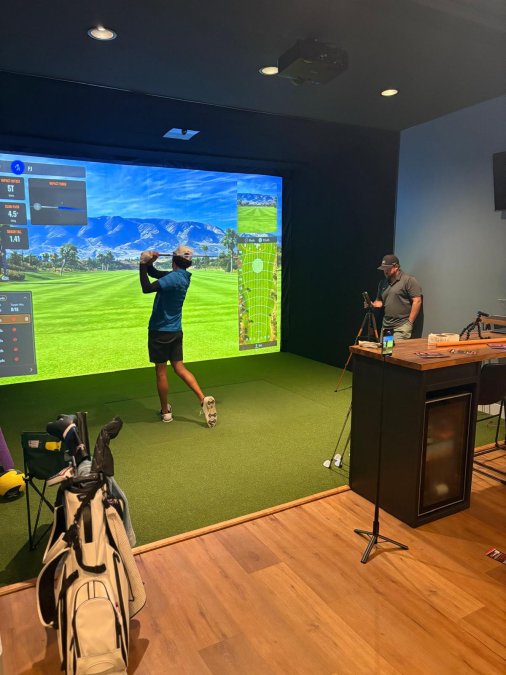
At SVN2 Indoor Golf, structure your practice around drills targeting your specific weaknesses:
Distance control drills:
- Hit 10 shots with each club and note the distance
- Adjust your swing to hit specific yardages (150, 160, 170 yards)
- Use Trackman data to verify consistency
Accuracy drills:
- Hit 20 shots at a target, trying to land within 10 yards
- Track how many hit your target zone, then narrow it
Short game drills:
- Pitch 20 shots from 50 yards and measure distance control
- Chip 20 shots from the fringe and count how many get close
- Practice 3-foot putts until you make 10 in a row
Pressure drills:
- Set a target score for your session and track performance against it
- Use Trackman data to see how pressure affects your swing
The key is repetition with measurement, hitting balls with a specific target, tracking results, and adjusting technique based on data. This is how you lower your handicap fast.
Improve Distance Control and Club Selection
Distance control is the foundation of course management. If you don't know how far each club goes, you'll make poor decisions.
At SVN2 Indoor Golf, establish your club distances with precision:
- Hit 10 full-swing shots with each club
- Record carry distance (not roll) from Trackman data
- Note the average and the range (shortest to longest)
- Repeat every 4 weeks to track consistency
Once you know your distances, club selection becomes simple, you pick the club that reaches your target. Most golfers overestimate by 10-15 yards, thinking they hit a 7-iron 165 when it's actually 150, which leads to missed greens. Trackman removes the guesswork.
Lower Your Golf Handicap Fast: Your Action Plan
Here's your roadmap to improvement:
| Step | Action | Frequency | Measurement |
|---|---|---|---|
| 1 | Establish baseline handicap and statistics | Once | Current handicap index |
| 2 | Analyze Trackman data at SVN2 Indoor Golf | Weekly | Identify top 3 weaknesses |
| 3 | Build focused practice plan | Once | Written plan with targets |
| 4 | Execute drills with precision | 2-3x per week | Track results each session |
| 5 | Review progress and adjust | Every 4 weeks | Compare metrics to baseline |
Start this week. Book a session at SVN2 Indoor Golf, hit 20 shots with each club to record your distances, spend 30 minutes on short game drills, and get your Trackman data.
The golfers who lower their handicap fast combine three things: clear weaknesses identified through statistics, focused drills targeting those weaknesses, and precise measurement of improvement. SVN2 Indoor Golf gives you all three.
Frequently Asked Questions
How quickly can I lower my golf handicap using Trackman simulators?
The speed of improvement depends on your starting handicap and practice frequency. Golfers who use Trackman data to identify specific weaknesses and practice targeted drills at SVN2 typically see measurable progress within 4-6 weeks of consistent sessions. Focus on your highest-impact areas, short game, distance control, and consistency, rather than random practice.
What golf statistics should I track to improve my game?
Track ball flight data (launch angle, spin rate, carry distance), short-game accuracy from different distances, putting consistency, and penalty shot frequency. SVN2's Trackman simulators provide all this automatically. Compare these metrics session-to-session to identify patterns. Golfers who monitor these statistics improve faster because they practice with purpose instead of guessing.
Can I really improve my handicap at an indoor golf simulator?
Yes. Trackman simulators at SVN2 are accurate enough to replicate real-course conditions and provide swing data that transfers directly to the course. The key is using the data to practice specific drills, not just hitting balls. Many golfers see handicap reductions of 2-4 strokes within 2-3 months when they combine simulator practice with a structured improvement plan focused on their weaknesses.
What's the best golf handicap improvement plan for someone with limited time?
Prioritize short game and distance control over long drives. Spend 60% of your SVN2 sessions on chipping, pitching, and approach shots, and 40% on full-swing consistency and club selection. Even 30-minute focused sessions twice weekly outperform longer, unfocused practice. Use Trackman data to identify your two biggest weaknesses and drill those every visit until improvement plateaus.
Lowering your golf handicap fast requires data, focus, and the right environment. SVN2 Indoor Golf's state-of-the-art Trackman simulators give you detailed swing analysis for every shot you take. You can zone in on your specific yardages, identify your miss patterns, and track improvement week to week. With fully self-service facilities and flexible pay-as-you-go pricing, you can practice on your own schedule. Book your first session now and start building the improvement plan that works.