 how-to
How to Improve Your Golf Swing Mechanics Indoors
Last Updated: October 28, 2026
Quick Summary
Improve golf swing mechanics indoors by using a simulator to measure club path, face angle and smash factor, then working on one metric at a time with targeted drills. Focus on the face first, then the path, and recheck both numbers together. Consistent sessions and a clear goal make the changes stick.
- Read club path, face angle and smash factor together before changing anything.
- Fix the clubface first by checking grip, then shallow the path with the gate drill.
- Aim for a face within about two degrees of square to your target line.
- Keep a path within two or three degrees of your target line as a realistic session goal.
- Stay on one fault for at least three sessions before switching to another problem.
Table of Contents
- Why Indoor Practice Works for Swing Mechanics
- Setting Up Your Session at SVN2
- Reading Your TrackMan Data: Club Path, Face Angle and Smash Factor
- Golf Swing Path Drills for the Simulator Bay
- How to Fix a Golf Slice Indoors
- Building a Practice Routine for Consistency
- Booking Your Next Training Session at SVN2
- Frequently Asked Questions
Why Indoor Practice Works for Swing Mechanics
At SVN2 Indoor Golf, our Trackman simulators provide detailed swing data, so you can study your golf swing mechanics.

The research on golf swing mechanics supports a data-first approach. A 2005 analysis of the golf swing's work and power, published in the Journal of Sports Science and Medicine treats the swing as a measurable system of energy transfer, which is the same framework a simulator uses to break your swing into numbers.
- Consistent conditions make cause and effect easier to spot
- Real-time numbers replace guesswork
- You can repeat the same drill until the change sticks
Setting Up Your Session at SVN2
Start by arriving with a clear goal. A session built around one problem, such as an early release or an open clubface, gives you a focus for your practice.
Once you're in the bay, check three things before your first swing:
- Confirm your setup: Stand in your normal address position and make sure the simulator's view matches where you aim.
- Warm up with a few smooth swings: Use short irons first so your tempo settles before you reach for the driver.
- Pick one metric to watch: Choose one number to track for the whole session, then review the rest afterward.
Keep your session focused. Our self-service format lets you control the pace, so you can take a few swings, check the data, adjust, and repeat.
Reading Your TrackMan Data: Club Path, Face Angle and Smash Factor
Read the numbers together. A slice often shows a left-to-right path combined with an open face. Check all three before you change anything, because fixing one number can shift another.
The article names three numbers to read together when diagnosing a slice.
| Metric | What it shows | Why read it with the others |
|---|---|---|
| Club path | Direction the clubhead travels at impact | A left-to-right path often causes a slice |
| Face angle | Clubface direction at impact | An open face sends the ball right |
| Smash factor | Energy transfer from club to ball | Shows whether strike quality holds as you adjust |
Golf Swing Path Drills for the Simulator Bay
Path problems respond well to drills that give you a clear target. Try these in the simulator bay:
- Gate drill: Place two alignment sticks or tees just outside the ball on your target line to create a narrow gate. Swing through without touching either one.
- Pump drill: Take the club halfway back, then bring it down to the impact position three times before a full swing. This builds the correct path into your motion.
- Path check: Hit five balls and watch the club path number after each one. Adjust your aim or alignment until the path number settles close to your target line.
Watch the club path and face angle readings after every drill. Aim for a path within a few degrees of your target line before you move to full swings.
How to Fix a Golf Slice Indoors
Work through these checkpoints in order, and do not move to the next one until the current number stabilizes:
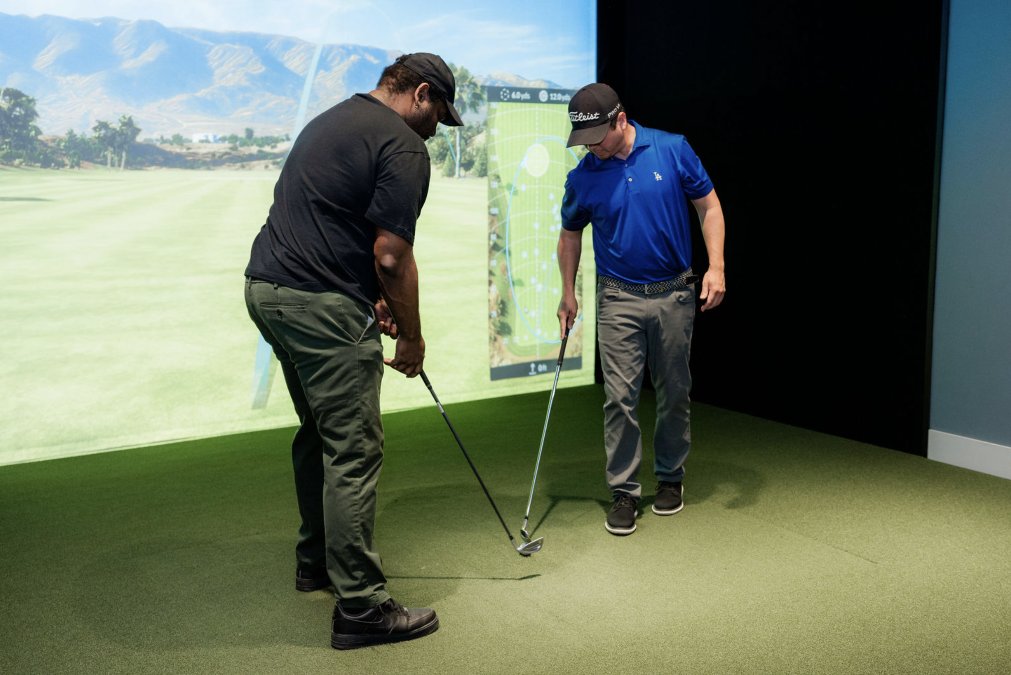
- Confirm the face first. A weak grip, hands rotated too far left on the handle for a right-handed player, leaves the face open at impact no matter how good your path is. Adjust the grip so you can see two knuckles on your top hand at address, then hit five balls and watch the face angle reading. Your target is a face within about two degrees of square to your target line. If the face number does not move after two grip adjustments, stop and re-check your setup alignment in the bay before continuing.
- Then shallow the path. Once the face is closer to square, use the gate drill from the previous section to bring the clubhead from the inside on the downswing. Place two alignment sticks just outside the ball on your target line and swing through the gate without touching either one. Hit five balls, check the path number, and repeat. A path that reads within two or three degrees of your target line is a realistic session goal.
- Recheck both numbers together. Take ten full swings and compare the face and path readings to your baseline. If the face improved but the path got steeper, you have traded one fault for another, go back to the gate drill and slow your tempo down until the path number settles.
Expect the first few changes to feel strange, especially the grip adjustment. Judge the fix by the numbers on the screen, not by feel, and give each change at least ten swings before you decide whether it is working. Book a follow-up session within a week so the new pattern has a chance to stick before your next round.
Building a Practice Routine for Consistency
A focused 50-minute session in the bay breaks down like this:
- Warm-up (10 minutes): Short irons with smooth tempo. Do not look at the numbers yet, just get your body moving and your tempo settled.
- Focus block (20 minutes): One drill, one metric, measured repeatedly. If you are working on path, watch only the path number. Ignore face angle and smash factor until the block is over.
- Full-speed test (15 minutes): Move to the driver and longer clubs to see whether the change holds up under full swing speed. This is where most indoor fixes fall apart, so give it real attention.
- Review (5 minutes): Record your best and worst readings for the session in a notes app on your phone. Note the date, the drill you used, and the metric you tracked.
Book sessions on a regular cadence, twice a week works well for most golfers, and keep the same metrics in your log each time so the numbers stay comparable. Our data-driven steps for lowering your handicap show how to structure this over time. If you are working on a specific fault, stay on that fault for at least three sessions before switching. Jumping between problems every visit is the most common reason indoor practice fails to translate to the course.
Our self-service format lets you control the pace of your practice.
Booking Your Next Training Session at SVN2
Ready to put this plan into practice? Book your next session at SVN2 Indoor Golf.
Our simulators provide detailed swing data. Our pay-as-you-go model lets you practice on your own terms. Visit SVN2 Indoor Golf to book now.
Frequently Asked Questions
How can I improve my golf swing mechanics indoors?
SVN2 Indoor Golf offers TrackMan simulators with detailed swing data to help golfers analyze their swings.
Can indoor golf practice help fix a slice?
SVN2 Indoor Golf offers TrackMan simulators with detailed swing data for golfers who want to analyze their swings.
How often should I practice golf indoors to improve?
SVN2 Indoor Golf offers pay-as-you-go practice. For current session pricing, check the SVN2 Indoor Golf website or request a quote.
What swing metrics should I focus on when practicing indoors?
SVN2 Indoor Golf's TrackMan simulators provide detailed swing data for golfers to review.