 how-to
Best Way to Practice Golf Alone: A Step-by-Step Guide
Table of Contents
- Why Solo Practice Matters for Golf Improvement
- Building Confidence Through Purposeful Solo Practice
- Golf Simulator Practice Drills to Master Every Skill
- Structuring Your Solo Golf Practice Routine
- Maximizing Your TrackMan Practice Session
- Golf Practice Drills for Winter and All-Weather Training
- Measuring Progress Without a Playing Partner
- Setting Achievable Goals to Stay Motivated
- Frequently Asked Questions
Last Updated: October 5, 2026
Why Solo Practice Matters for Golf Improvement
Solo practice is where serious golfers refine their game. When you practice golf alone, you control every variable: pace, focus, and feedback. No waiting on partners, no distractions, no pressure to keep up. This is where deliberate improvement happens.
The challenge is knowing what to work on. Random ball-striking builds nothing; purposeful practice targeting specific weaknesses transforms your game. At SVN2 Indoor Golf, our facilities are built for golfers who want to practice with intent.
Solo practice also removes the mental burden of performance. With no score and no competition, you can focus entirely on technique, consistency, and confidence in your swing mechanics.
Building Confidence Through Purposeful Solo Practice
Confidence comes from repetition and measurable progress. When you practice golf alone with a clear purpose, you create the conditions for real growth.
Start by identifying one specific weakness, inconsistent ball striking, or a short game that falls apart under pressure. Pick one issue and dedicate entire sessions to it.
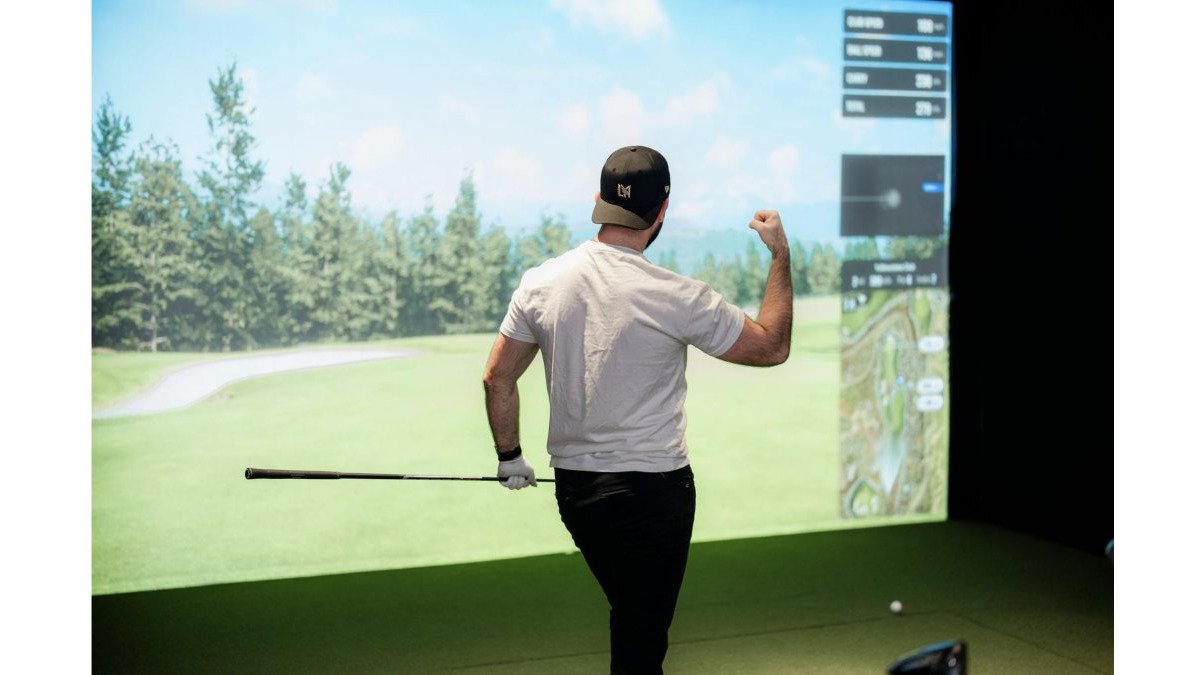
Track your progress visually. At SVN2 Indoor Golf, Trackman data shows you:
- Club head speed and ball speed
- Launch angle and spin rate
- Carry distance and accuracy patterns
- Shot dispersion across multiple attempts
Seeing these metrics improve session after session builds genuine confidence. You're not relying on feel, you have proof you're getting better.
Practice the same shots repeatedly until they feel automatic. A golfer who hits 50 different shots learns nothing; one who hits the same shot 50 times builds a repeatable swing.
Golf Simulator Practice Drills to Master Every Skill
Indoor simulators let you practice every part of your game in one session.
Short Game Drills
The short game decides most tournaments. Practice these drills at SVN2 Indoor Golf to sharpen your touch around the greens.
Chip Shot Progression: Start 15 yards from the green and chip to a target zone. Complete 10 successful chips, then move back 5 yards, continuing to 40 yards.
Half-Swing Accuracy: Hit 20 half-swing shots from 30 yards at different target zones.
Pressure Chip Routine: Simulate tournament pressure by making 5 chips in a row from 20 yards. Miss one and restart. This builds mental toughness and one-shot focus.
Putting Drills for Distance Control
Putting is where scores are made. Distance control matters more than line, miss the distance and you're looking at a three-putt.
Long Putt Distance Control: Start at 40 feet, putting to a target zone within 3 feet of the hole. Complete 10 putts, then move to 50 feet.
Medium Putt Consistency: From 15 feet, putt 20 balls to different hole locations. Medium putts should feel automatic.
Short Putt Pressure Series: From 5 feet, make 10 putts in a row. Miss one and restart. This builds the mental resilience tournament golf demands. Short putts should be non-negotiable.
Full Swing Drills
Your full swing is the foundation. Practice these drills to build consistency and distance control.
Target Distance Ladder: Hit balls at specific yardages (150, 160, 170, 180 yards), completing 5 shots at each before advancing.
Fairway vs. Rough: Hit 10 shots from the fairway, then 10 from rough. Rough shots require a different swing path. Practicing both conditions prepares you for real-world golf.
Shot Shape Progression: Hit 5 straight shots, then 5 draws, then 5 fades. Shot-shaping control gives you options when you need them, and the simulator shows ball flight and landing pattern for each shape.
Structuring Your Solo Golf Practice Routine
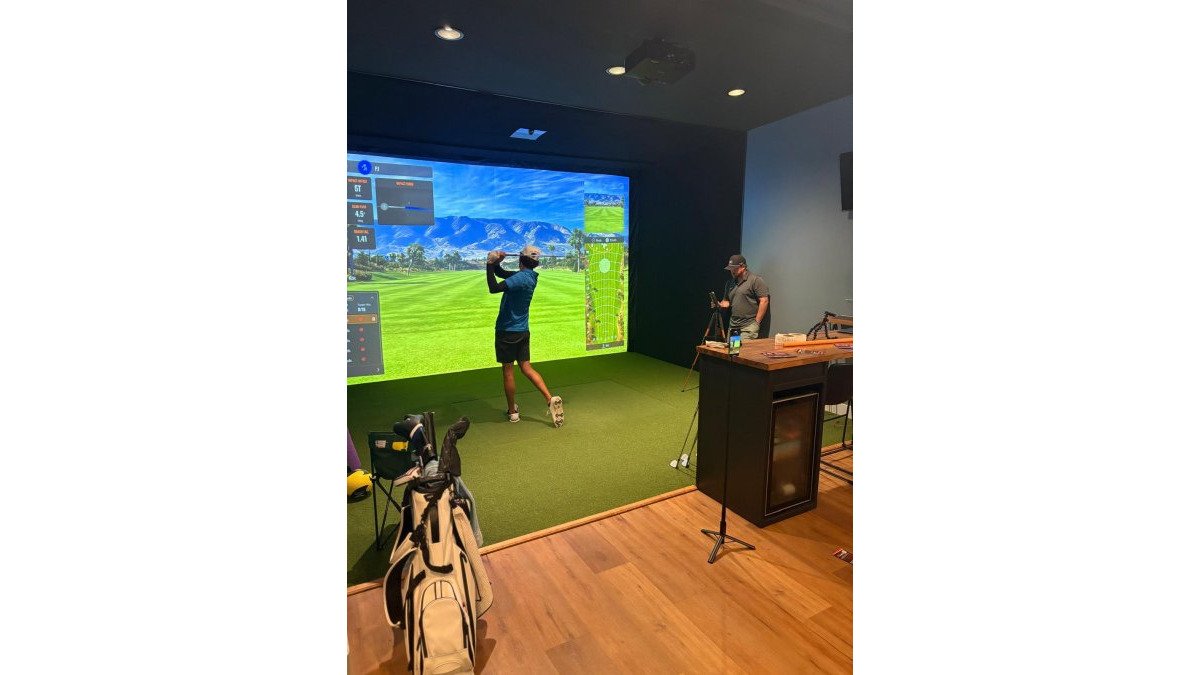
A solo session without a clock turns into random ball-striking. The fix is a fixed-length plan with named blocks, shot counts, and a defined finish. The 60-minute template below is built for a single SVN2 Indoor Golf bay.
The 60-Minute Solo Session Template
| Block | Time | Shots | Purpose |
|---|---|---|---|
| Warm-up | 8 min | 15-20 | Find tempo, no targets |
| Skill block A | 15 min | 25-30 | Primary weakness |
| Skill block B | 12 min | 20-25 | Secondary weakness |
| Pressure block | 15 min | 15-20 | Score a game |
| Cool-down review | 10 min | 0 | Log data, set next focus |
Warm-up (8 minutes). Hit 15-20 mid-iron shots at 60-70% effort. No targets, no data review, the goal is rhythm. Finish with three full-speed swings so your body knows game speed.
Skill block A (15 minutes). Your primary weakness. For approach accuracy, run the Target Distance Ladder; for short game, the Chip Shot Progression.
Skill block B (12 minutes). Secondary weakness, 20-25 shots. Keep the same drill format so you're not learning a new task mid-session.
Pressure block (15 minutes). Pick one scored game.
Cool-down review (10 minutes). No more full swings.
Warm-Up and Pre-Shot Routine
The warm-up is not practice, it's a bridge from your car to your swing. Hit 10 easy mid-iron shots, then 5 fairway woods, then 3 drivers. Focus on contact, not direction.
Then lock in your pre-shot routine. You follow the same steps before every on-course shot, so rehearse them here:
- Step behind the ball and pick your target
- Take two practice swings
- Address the ball
- Execute
Run the full routine on every shot in the skill and pressure blocks. Skip it in the bay and it disappears on the course.
Adjusting the Template
- 30-minute session: Warm-up 5, one skill block 15, pressure 10.
- 90-minute session: Add a second pressure block and a 10-minute putting-only block.
- Pre-round tune-up: Warm-up 10, one skill block 10, pressure 10. Skip the review.
Practice Session Flow
Every session should move from low to high consequence: warm-up with no target, skill blocks with a target but no score, a scored pressure block, then a review with no swings. That progression trains your routine to hold up when the shot matters.
Maximizing Your TrackMan Practice Session
TrackMan data is only valuable if you know how to use it. Here's how to extract real improvement from every session.

Review your data in real time. After each shot, check:
- Ball speed and club head speed: power and efficiency
- Launch angle: too high or too low affects distance and accuracy
- Spin rate: excessive spin kills distance; too little loses control
- Dispersion pattern: are your misses consistent or random?
Consistent misses reveal a swing flaw; random misses suggest poor focus. Both are fixable once you see the pattern.
Compare metrics to previous sessions. If club head speed rose but accuracy dropped, you're swinging too hard. If launch angle is too high, you're scooping.
Set specific metric targets.
Golf Practice Drills for Winter and All-Weather Training
Weather shouldn't stop your progress. Indoor golf at SVN2 lets you practice year-round without delays.
Winter training has unique advantages: controlled conditions, sharper focus, and consistent data with no wind or temperature variables skewing results.
Use winter sessions to build fundamentals:
- Refine your pre-shot routine
- Work on swing mechanics without pressure
- Build consistency in your short game
- Dial in your distances with precision
Measuring Progress Without a Playing Partner
The simulator provides numbers, but only if you record the same metrics every session. Pick four, define them identically each time, and log them after every visit.
The Four Metrics That Matter
1. Target-hit rate. Pick a target zone (say, a 30-foot circle around a flag at 150 yards). Hit 10 shots and count how many finish inside.
2. Putting make percentage. From a fixed distance (5 feet is standard), hit 20 putts and count makes.
3. Dispersion width. After a 10-shot block with one club, note how wide your miss pattern is. If your 7-iron shots land in a 40-foot band, that's your dispersion.
4. Distance consistency. For a single club, note the difference between your longest and shortest carry in a 10-shot block. A tighter range means better distance control.
How to Log a Session
Keep the log to five lines. Anything longer and you'll stop doing it.
- Date and total time in the bay
- Primary focus (one phrase)
- Target-hit rate (fraction)
- Putting make percentage (three distances)
- One sentence on what to change next time
Setting a Baseline and Beating It
Your first session is a baseline, not a test. Record the numbers without judging them, then set a target one step better, not a leap. If your 5-foot make rate is 14/20, aim for 16/20 over four sessions. If your target-hit rate is 5/10, aim for 6/10.
Review the log monthly. Look for trends, not single sessions: a metric moving the right way across four weeks is real progress; one that bounces around is noise.
Using the Simulator to Verify
SVN2 Indoor Golf's Trackman setup records club head speed, ball speed, launch angle, spin rate, carry distance, and dispersion on every shot. Use those to confirm your manual log. If target-hit rate improved but dispersion didn't change, you got luckier, not better. If dispersion tightened but make percentage dropped, something in your stroke needs a look.
Why This Beats Feel
"I felt like I played well today" is not data. A target-hit rate of 7/10 versus 5/10 last week is. Over a season, the log becomes the only honest record of whether your solo practice is working.
Setting Achievable Goals to Stay Motivated
Vague goals produce vague results. "Get better at golf" doesn't work. Specific goals drive specific improvements.
Set goals across three categories:
Distance Goals: "Increase average driver distance by 5 yards" or "Hit 7-iron consistently to 165 yards." Trackman makes these measurable.
Accuracy Goals: "Reduce driver dispersion by 10 yards" or "Make 8 of 10 putts from 5 feet." These build confidence in specific shots.
Consistency Goals: "Hit the same club head speed on 8 of 10 swings" or "Keep launch angle within 2 degrees on 9 of 10 shots." Consistency translates to the course.
Review goals monthly. Hitting them? Set harder ones. Missing them? Adjust your practice focus. Goals aren't static, they evolve as you improve.
Frequently Asked Questions
What is the best way to practice golf alone?
The best way to practice golf alone combines purposeful drills, feedback mechanisms, and structured sessions. Use a TrackMan simulator to access real-time swing data on every stroke. Focus on one skill at a time, short game, putting, or full swing, rather than hitting random balls. Set specific targets and track your results across sessions. A typical solo practice session should last 45-90 minutes with clear warm-up, drill, and cool-down phases.
How can I measure progress when practicing golf by myself?
Track your performance using the detailed swing data available through TrackMan simulators. Monitor key metrics like ball speed, launch angle, distance consistency, and accuracy from different distances. Record your results after each session and compare them week-to-week. Set baseline measurements for your putting accuracy, short game distances, and full swing distances, then establish monthly improvement targets. This data-driven approach reveals patterns that aren't visible during casual practice.
What golf drills can you do on a simulator?
Simulators enable targeted drills across all skill levels. Practice short putts from 3-6 feet, medium putts from 15-30 feet, and long putts from 40+ feet to build consistency. Work on chipping and pitching from various lies around the greens. Groove half-swing, three-quarter, and full swing patterns with different clubs. Use distance control drills by targeting specific yardages with each club. Challenge yourself with different course conditions and lie scenarios that simulators can replicate.
How long should a solo golf practice session be?
Aim for 45-90 minutes for focused, purposeful practice. Shorter sessions of 30-45 minutes work if you target one specific skill. Longer sessions risk fatigue and loss of focus, which reduces the quality of your practice. Structure your time: 10 minutes warm-up, 30-50 minutes on primary drills, 10-15 minutes on secondary skills, and 5-10 minutes on mental preparation or pre-shot routine work. Quality and focus matter more than total session length.
Solo practice at SVN2 Indoor Golf gives you the data, environment, and feedback you need to improve faster. Our Trackman simulators eliminate guesswork. You see exactly what's working and what needs adjustment. Book a session and start practicing with purpose. You'll see measurable improvement in weeks, not months.