 blog
The Park Golf Lounge Alternatives: A 2026 Guide
Table of Contents
- Why Golfers Are Looking for Alternatives
- What to Look for in Indoor Golf Simulator Facilities
- Self-Service Golf Simulator Options That Deliver Results
- TrackMan Golf Simulator Practice: Why Data Matters
- Pay-as-You-Go Indoor Golf: Flexibility Without Commitment
- How to Choose the Right Facility for Your Goals
- Making Your Decision: Key Questions to Ask
- Frequently Asked Questions
Last Updated: October 11, 2026
Why Golfers Are Looking for Alternatives
Indoor golf simulator options have exploded, and golfers today want more than just a place to hit balls indoors, they're exploring golf lounge alternatives that deliver real data, flexible access, and a clear path to improvement. They want facilities that deliver real data, flexible access, and a clear path to improvement.
At SVN2 Indoor Golf, we understand what serious golfers are actually looking for: a space where you can practice on your own terms, access detailed swing analysis, and see measurable progress without the commitment of a traditional club membership.
Golfers seeking golf lounge alternatives fall into distinct groups: serious players want swing data and specific yardage control; casual groups want a relaxed environment for friendly competition; busy professionals need flexible scheduling; corporate teams want a unique venue. The best facility depends on what matters most to you.
What to Look for in Indoor Golf Simulator Facilities
When evaluating an indoor golf simulator facility, focus on technology quality, booking ease, pricing transparency, and data accessibility, the factors that directly affect your practice results.
Simulator technology and accuracy. TrackMan simulators capture precise ball data, launch angle, spin rate, carry distance, shot shape, club path, attack angle, letting you identify exactly what's holding back your swing (The Ultimate Guide to Understanding Trackman). Foresight GCQuad systems offer comparable accuracy. Lower-end simulators miss the nuances that separate serious improvement from guesswork. Ask which system the facility uses and request a sample data readout to verify the metrics are presented clearly enough to act on.
Booking and reservation policies. Top-tier facilities allow online booking with 24-hour cancellation windows and same-day reservations during off-peak hours. Ask the minimum booking window, cancellation policy, and whether walk-ins are accepted during slow periods. This flexibility is critical if your schedule is unpredictable.
Pricing structure and what's included. Verify what's included: all courses or premium layouts extra, swing analysis tools, per-person charges for groups. Request a written breakdown of bay rental, course access, data tools, and guest fees so you can compare true total cost across venues.
Facility environment and maintenance. Good lighting, comfortable temperatures, and sound isolation matter. Visit during the time of day you plan to practice most often. Ask about maintenance schedules; simulators require regular calibration to stay accurate.
Course selection and virtual play realism. Ask the facility to show you their course library and confirm that your home course or courses you play regularly are available. Some facilities update their course catalog seasonally.
Data accessibility and feedback tools. Verify that you can access session data after you leave, review downloadable reports, and compare metrics across multiple visits. Some facilities provide personal dashboards for tracking progress over weeks and months; others isolate data to each session.
| Factor | Why It Matters | What to Verify |
|---|---|---|
| Launch Monitor Technology | Accuracy of swing data | TrackMan or Foresight GCQuad; request sample data readout |
| Booking System | Convenience and flexibility | Online booking, same-day availability, cancellation window |
| Pricing Transparency | True cost comparison | Written breakdown of bay fees, course access, per-person charges |
| Facility Quality | Comfort and focus | Lighting, temperature, sound isolation, maintenance schedule |
| Course Library | Relevance to your game | Verify your home courses are available |
| Data Tools | Actionable improvement | Access to session history, trend reports, downloadable metrics |
Self-Service Golf Simulator Options That Deliver Results
The self-service golf simulator model removes friction from your practice routine. You control when you practice, how long you stay, and which courses you focus on.
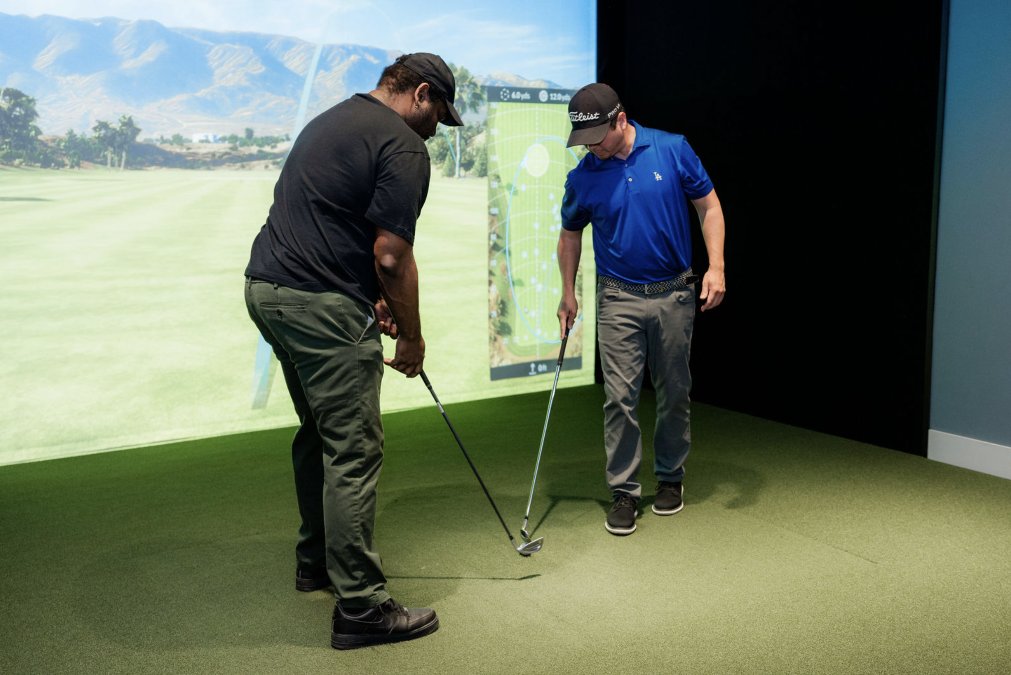
SVN2 Indoor Golf operates fully self-service facilities designed for golfers who want to practice smarter. You book a bay, load your session, and get immediate access to detailed swing metrics. TrackMan simulators track ball speed, launch angle, spin axis, and carry distance, data that becomes your training roadmap.
Self-service works best for golfers who know what they're trying to improve. Work on distance control with mid-irons by hitting different targets and watching how swing changes affect your numbers. Dial in your driver by running multiple shots and seeing the pattern in your misses. Refining these technical mechanics in a controlled environment provides a solid foundation for testing your consistency across the diverse terrain found at local golf courses.
You're not locked into a membership or lesson schedule. Practice when your calendar allows, once a week for 90 minutes or multiple shorter sessions. The facility adapts to your life.
TrackMan Golf Simulator Practice: Why Data Matters
Golf is one of the few sports where you can hit a shot and have no idea what caused the result. TrackMan changes that equation by producing measurable data that explains what happened and why.
When you practice with TrackMan data, you stop guessing. Patterns emerge quickly: your driver launch angle is too low, your 7-iron spin rate is inconsistent, or you're losing yards to a slice you didn't fully recognize.
This level of feedback accelerates improvement. Hit 15 balls, see the data, adjust your setup, and verify the change worked. That's deliberate practice, how golfers break through plateaus.
Seeing your own data changes perspective. What felt like a solid swing might show up as a launch angle issue. What you thought was a timing problem might be a club path concern. Data removes emotion from diagnosis.
Pay-as-You-Go Indoor Golf: Flexibility Without Commitment
The pay-as-you-go model solves a real problem for busy professionals and casual players. You're not locked into a contract, you pay for the time you actually practice and book sessions on your schedule.
How pay-as-you-go pricing typically works. Most facilities charge an hourly bay rental fee with discounts for off-peak hours (weekday mornings and early afternoons) and higher rates for peak times (weekday evenings and weekends). Some facilities offer tiered pricing or seasonal adjustments. Ask for their full rate card so you can budget accurately and plan sessions during times that fit your schedule and budget.
Reservation windows and cancellation policies. Ask the minimum booking window and cancellation policy. A 24-hour cancellation window gives flexibility; 48-72 hour windows are more restrictive. Some facilities charge cancellation fees if you cancel within a certain timeframe. Confirm these terms in writing before booking.
Walk-in availability and peak-time constraints. Some facilities accept walk-ins during slow periods; others require advance booking. Ask whether walk-ins are accommodated and during which hours. Peak times (typically 5-8 PM weekdays, 10 AM-4 PM weekends) often require advance reservation. Off-peak hours (weekday mornings and early afternoons) are more likely to have open bays.
Multi-session packages and discounts. Even though pay-as-you-go has no membership requirement, many facilities offer discounted rates if you purchase a package of sessions upfront, for example, 10 hours at a 10-15% discount, or 20 hours at a 20% discount. These packages still have no long-term commitment; you simply prepay for a block of time and use it at your own pace.
Why pay-as-you-go works for different golfer types. Busy professionals benefit because there's no membership pressure. If you travel for work or have unpredictable hours, you can book a session when you're back in town without worrying about unused membership fees. Casual golfers appreciate the flexibility to practice twice a month in winter and once a week in summer, matching your spending to your actual activity level.
Comparing total cost across venues. To make a fair comparison, calculate your expected monthly usage and multiply by the facility's hourly rate. If you plan to practice 8 hours per month and a facility charges $50 per hour off-peak, your monthly cost is $400. If another facility charges $45 per hour but requires a $100 monthly membership, your cost is $460.
How to Choose the Right Facility for Your Goals
Start by clarifying what you actually want from indoor golf practice. Are you training to lower your handicap, or are you looking for a fun social venue? Do you want coaching, or do you prefer self-guided practice? Are you in the facility 2 hours or 30 minutes?
Your answers determine which facility fits best. A serious golfer focused on swing mechanics needs excellent simulator technology and detailed data. A casual group wants a relaxed environment and easy access. A busy professional needs flexible scheduling and quick sessions.
Consider your location and travel time. A facility 15 minutes away gets used far more often than one 45 minutes away. Convenience compounds over months of practice.
Test the facility before committing. Most quality indoor golf simulator venues let you book a single session. Use that session to evaluate the technology, the environment, and whether the data presentation makes sense to you. Pay attention to how easily you can navigate the system and whether staff are responsive if you have questions.
Ask about course options and whether the virtual play feels realistic. Some facilities have limited course libraries. Others offer dozens of layouts. If you play specific courses regularly, verify they're available.
Making Your Decision: Key Questions to Ask
Before booking your first session, ask the facility these specific questions:
What simulator technology do you use? TrackMan and Foresight GCQuad are industry standards. If they're using something else, ask why and whether the accuracy is comparable.
Can I book online, or do I need to call? Online booking is faster and more convenient. Phone-only booking creates friction.
What's included in a session? Do you get access to all courses, or are premium courses extra? Are lessons available, and do they cost more?
How busy are peak times? If you want to practice at 6 PM on weekdays, you need to know whether bays are available or if you'll face long waits.
What's the cancellation policy? Life happens. A reasonable cancellation window protects you if plans change.
Can I bring my own clubs? Most facilities allow it, but confirm. Some have rental clubs if you prefer.
Do you offer any community memberships or discounts? SVN2 Indoor Golf offers community memberships for students, faculty, first responders, seniors, and veterans. Ask whether the facility you're considering has similar programs.
The right golf lounge alternative is the one that matches your schedule, your goals, and your budget. Don't choose based on proximity alone or the fanciest marketing. Choose based on whether the technology delivers the data you need, whether the facility is accessible when you want to practice, and whether the environment supports your improvement.
Finding the right indoor golf simulator facility means matching your practice style to a space that supports it. If you're serious about using data to improve, you need TrackMan-level accuracy and self-service access that lets you practice on your schedule. SVN2 Indoor Golf delivers exactly that, state-of-the-art Trackman simulators, fully self-service bays, and the flexibility to practice whenever your calendar allows. Whether you're dialing in specific yardages or analyzing swing mechanics, our facilities give you the detailed feedback you need to practice smarter and improve faster. Book Now and start your data-driven training today.
Frequently Asked Questions
What should I look for in an indoor golf practice facility?
Prioritize simulator accuracy (TrackMan delivers the most reliable ball-tracking data), self-service accessibility so you can practice on your schedule, and detailed swing analytics that help you identify specific areas to improve. Flexible pay-as-you-go options work best if you don't want membership obligations. Check whether the facility offers course selection for variety and whether you can book a private bay if you prefer focused practice without distractions.
Can I book an indoor golf simulator without a membership?
Yes. Many facilities, including those offering pay-as-you-go models, allow drop-in access without membership requirements. This approach works well for golfers who practice sporadically or want to test a facility before committing. Verify booking policies directly with your chosen venue, some require advance reservations during peak hours, while others accept walk-ins. Self-service facilities often provide the most flexible scheduling since you control your session length and timing.
What data can a TrackMan golf simulator provide?
TrackMan simulators capture ball speed, launch angle, spin rate, carry distance, and shot direction with high precision. This data helps you understand your swing tendencies, dial in yardage for each club, and identify mechanical issues affecting consistency. Over multiple sessions, you can track progress and see whether specific adjustments are working. Golfers serious about improvement use this feedback to practice with purpose rather than simply hitting balls.
Is a self-service golf simulator facility a good option for practice?
Self-service facilities work exceptionally well if you know what you want to work on and prefer independent practice. You control the pace, choose your courses, and spend as much time analyzing data as you need. This setup suits golfers who geek out on swing metrics or want to zone in on specific yardages without an instructor present. If you're newer to golf or prefer guided coaching, a facility offering optional lessons alongside self-service access provides the best of both worlds.